
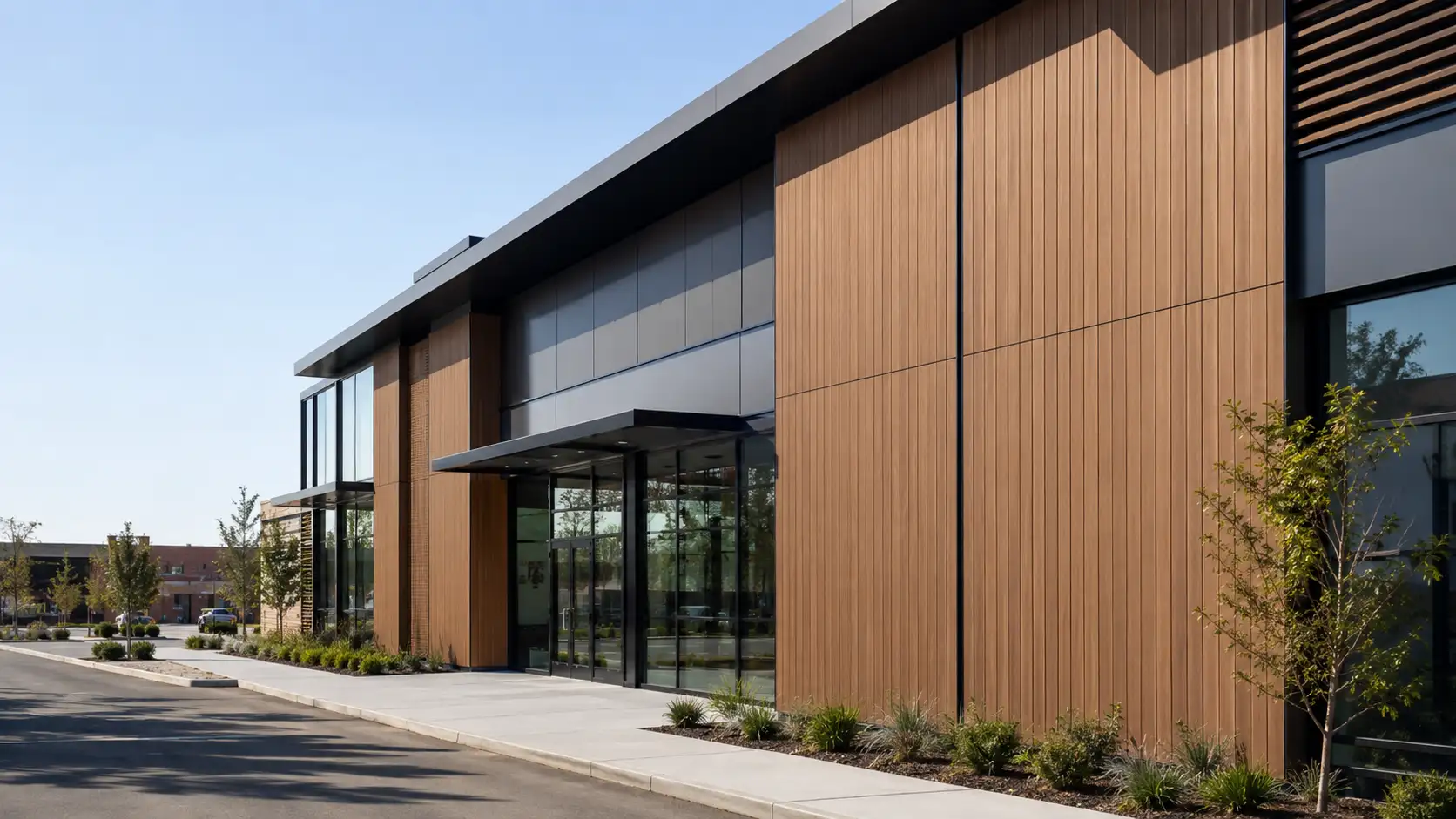
WPC Wall Panels: The Complete Guide 2026
WPC wall panels give you the look of real timber with the behavior of engineered plastic. You get a 20–30 year service life and water absorption near 1.5% or less. The category is growing fast, too. As of 2026, the global wood-plastic composite market is worth about USD 9.63 billion and is forecast to reach USD 14.57 billion by 2031, a compound annual growth rate of 8.64%.
So why is the buying decision still confusing? The market is full of vague claims. And most online “guides” come from resellers who never see a production line. At WYRAX, we work from the manufacturing side of decorative building materials across wall materials, floor materials, and ceiling materials. This guide explains what WPC wall panels are, the types you can buy, how they actually perform, where they fit, how they compare to alternatives, and how to vet a supplier before you commit.
Key Takeaways
- WPC wall panels blend roughly 40–70% wood fiber with thermoplastic, giving a wood look with ≤1.5% water absorption and a 20–30 year lifespan.
- Quality panels can meet EN 13501-1 B-s1,d0 (Europe) or ASTM E84 Class A (North America) fire ratings.
- The global WPC market reaches ~USD 9.63B in 2026 at ~8.6% CAGR; building and construction is the dominant segment at 75.7%.
- For B2B buyers: source from a real decorative building materials manufacturer, not a trader, and verify ISO, CE, SGS, and REACH before you discuss MOQ.
Table of Contents
- What Is a WPC Wall Panel?
- How Are WPC Wall Panels Made?
- Main Types of WPC Wall Panels
- What Are the Pros and Cons of WPC Wall Panels?
- How Durable Are WPC Wall Panels?
- Do WPC Wall Panels Fade in Sunlight?
- Are WPC Panels Fire Resistant and Safe?
- Common WPC Wall Panel Applications
- WPC vs PVC, Aluminum, Real Wood, and Fiber Cement
- How Much Do WPC Wall Panels Cost?
- How Do You Install and Maintain WPC Panels?
- How Do You Source WPC Panels and Choose a Manufacturer?
- Frequently Asked Questions
- What is a WPC wall panel made of?
- How long do WPC wall panels last?
- Are WPC wall panels waterproof?
- Are WPC wall panels fire resistant?
- What certifications should WPC panels have for import?
- What is the difference between WPC and SPC panels?
- Can WPC wall panels be repaired or repainted?
- Conclusion
- About the author
- Sources
What Is a WPC Wall Panel?
A WPC wall panel is an engineered board made by extruding a blend of wood fiber and thermoplastic. A typical formulation runs about 40–70% wood fiber, 25–40% polymer such as PE, PP, or PVC, up to 20% mineral filler, and 1–5% additives. The board looks like wood but resists the things that ruin wood.
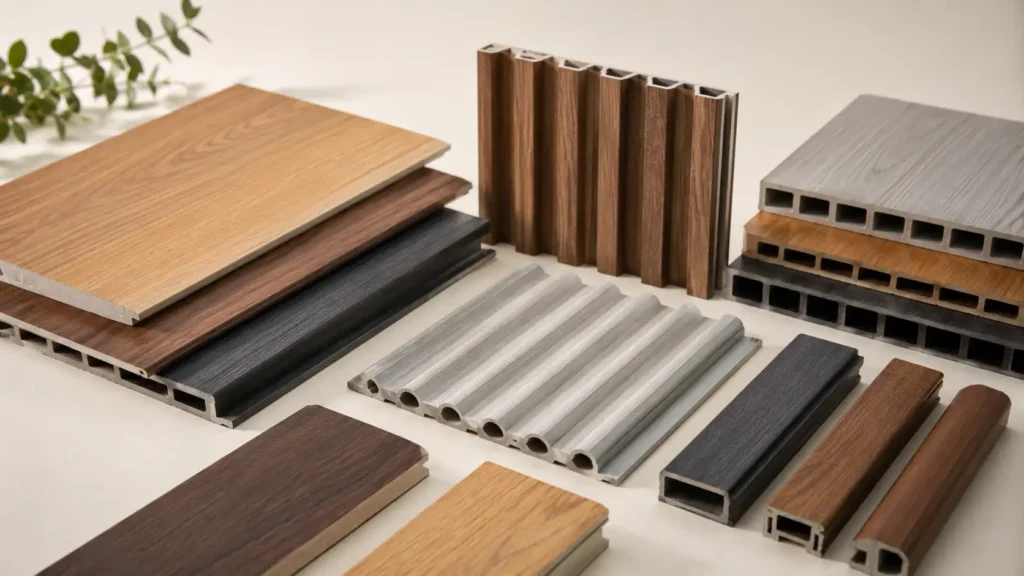
The manufacturing matters more than most buyers realize. Wood fiber and polymer are mixed under heat and pressure until every particle is fully encapsulated. The mix is then forced through a die. That process, called extrusion, dominates the industry: it accounted for 70.36% of WPC production in 2025 (Mordor Intelligence). The encapsulation step is what locks moisture out.
“WPC” is not one fixed recipe. The wood-to-polymer ratio, the filler, and the additive package all change how a panel performs. Two boards that look identical can behave very differently in sun, rain, or fire. WPC Wood fiber ~55% Thermoplastic ~32% Mineral filler ~10% Additives ~3% Representative formulation; ratios vary by product.
A WPC wall panel combines about 40–70% wood fiber with 25–40% thermoplastic, extruded into a board that mimics timber while resisting moisture, rot, and pests. The polymer content is the lever that controls water resistance and dimensional stability. Higher polymer means lower water uptake.
How Are WPC Wall Panels Made?
WPC manufacturing runs on extrusion, which made up 70.36% of WPC production in 2025 (Mordor Intelligence). The process moves through four stages. First, wood flour is dried to strip out moisture. Second, it is compounded with polymer, filler, and additives into pellets. Third, the pellets melt and pass through a shaped die. Fourth, the board cools, gets cut, and is embossed or sanded.
Each stage shifts the final quality. Poor drying traps moisture and weakens the board. A thin additive package fades fast outdoors. That is why two panels with the same wood-to-plastic ratio can still perform differently, and why factory control beats buying on price alone.
For the full material breakdown, see our guide to what WPC is and what wood composite is made of.
Main Types of WPC Wall Panels
WPC wall panels come in a few structural and decorative formats, and the difference affects both price and performance. The three structural types are hollow, solid, and co-extruded. Hollow boards are lighter and lower in cost. Solid boards are denser and tougher. Co-extruded boards add a protective polymer cap that improves UV and scratch resistance.
By style, the common profiles are flat cladding boards, fluted panels with vertical ribs and slatted panels used for acoustic walls. Each suits a different look. Fluted panels read as premium and work well on feature walls. Flat cladding boards are the workhorse for facades.
From the WYRAX: for exterior projects in strong sun, we steer buyers toward co-extruded boards. The capped surface holds color far longer than an uncapped budget board, and that single choice prevents most of the fade complaints we used to see.
Thickness and size matter too. Interior panels often run 6–9 mm, while exterior cladding uses thicker 10–22 mm boards for rigidity and impact resistance. Wider boards cover a wall faster but show more thermal movement, so longer runs need more expansion allowance. Match the board to the wall’s exposure and span before you order.
Which type is right? It depends on the project. Indoor feature walls usually fit lighter hollow or fluted WPC panels, especially when the goal is a clean decorative surface with vertical texture. Sound-focused interiors are better served by acoustic panels, where the slatted face and acoustic backing help reduce echo in offices, hotels, studios, and meeting rooms. Exterior facades in harsh climates are better served by solid or co-extruded boards. For decorative interiors, start with our fluted panels; for sound-focused spaces, see our acoustic panels.
What Are the Pros and Cons of WPC Wall Panels?
WPC wall panels deliver a 20–30 year lifespan and ≤1.5% water absorption, but they cost more upfront than vinyl and move with temperature. The honest summary: WPC wins on durability and looks, and it asks for careful installation in return.
The advantages are clear. WPC resists rot, moisture, and pests. It needs no sealing or painting. It carries a real wood grain. It works inside and outside. And quality boards can reach Class-A fire ratings.
The trade-offs are just as real. WPC expands and contracts more than timber, so expansion gaps are not optional. Budget boards without a UV cap can fade. The upfront price sits above vinyl. Surface scratches on uncapped boards are also harder to sand out than on solid wood.
So when should you skip WPC? If a job needs the lowest possible material cost and looks do not matter, vinyl may fit better. If it demands a fully non-combustible facade, aluminum or fiber cement win. For most wood-look projects that must last, though, WPC is the balanced choice.
For a deeper look at WPC durability, read our full guide: “Is WPC Durable?”
How Durable Are WPC Wall Panels?
WPC wall panels last 20–30 years on average. Indoors, where there is no UV or freeze-thaw stress, they often pass 30 years. As exterior cladding, expect 15–20 years depending on climate and panel quality. That beats untreated timber, which usually needs replacing or heavy upkeep within 10–15 years.
Water is wood’s worst enemy. It is also where WPC earns its keep. A quality panel absorbs 1.5% or less water after 24 hours of submersion, with a swelling rate under 0.5%. Because so little water gets in, the panels do not rot, warp, or grow mold the way solid wood does.
Want the honest caveat? WPC expands and contracts with temperature more than timber. So installation gaps matter. Lower-polymer budget boards also fade faster under strong sun. This is exactly why formulation and a UV-stable cap layer are worth asking about.
Here is a representative WYRAX WPC wall panel spec sheet:
| Property | Typical WYRAX WPC spec | Why it matters |
|---|---|---|
| Water absorption (24h) | ≤ 1.5% | No rot, warp, or mold |
| Density | ~1.25–1.35 g/cm³ | Impact and dent resistance |
| Thickness range | ~6–22 mm | Interior vs exterior load |
| Fire class (available) | EN 13501-1 B-s1,d0 / ASTM E84 Class A | Code compliance for hotels and commercial |
| Surface | Co-extruded UV cap (optional) | Long-term color retention |
| Service life | 20–30 years | Lower cost per year vs timber |
Representative WYRAX product range; confirm exact values against the current datasheet for your order. WPC25 yrs PVC / vinyl20 yrs, estimated figures are for reference only.
Do WPC Wall Panels Fade in Sunlight?
Some color change is normal in the first few months, and then it stabilizes. Quality co-extruded boards carry UV inhibitors in the cap layer, which holds color far longer than uncapped budget boards. Reputable panels are rated for limited color shift over years of exposure, though the rate depends heavily on the additive package and the local climate. For sun-heavy projects, a capped board is the safer specification.
Dig into testing, lifespan, and upkeep in “Is WPC Durable?“and the performance ratings in “Fire Resistant & Waterproof?“.
Are WPC Panels Fire Resistant and Safe?
Yes. Quality WPC panels reach strong fire classifications when they include flame-retardant additives. Two standards matter. The European EN 13501-1 defines the top relevant class as B-s1,d0, meaning low flammability, low smoke, and no flaming droplets. The North American ASTM E84 Class A requires a flame spread index of 25 or less and a smoke developed index of 450 or less.
Why does this matter so much for hotels, offices, and other commercial spaces? Because fire class is often a hard line in the building code, not a nice-to-have. A panel without a documented rating cannot be specified, no matter how good it looks.
There is an environmental angle as well. WPC is frequently made with recycled wood fiber and reclaimed plastic, which diverts waste and cuts demand for virgin material. Ask for VOC and formaldehyde data if indoor air quality is part of your spec.
From the WYRAX: a fire “rating” is only as good as the certificate behind it. Always ask which standard, which class, and which test body issued the report. A claim of “fire resistant” with no EN 13501-1 or ASTM E84 documentation is not specifiable.
We break down each certification in “Certifications (CE, SGS, Fire, ISO)“, with eco questions covered in “Are WPC Panels Eco-Friendly?”.
Common WPC Wall Panel Applications
WPC wall panels work both outside and inside. That versatility is why they show up everywhere from building facades to hotel lobbies. Their mix of low upkeep and a warm, wood-like finish suits high-end hotels, residential properties, and commercial fit-outs. These are the same project types WYRAX supports as a B2B decorative building materials brand serving wall, floor, and ceiling projects in more than 60 countries.
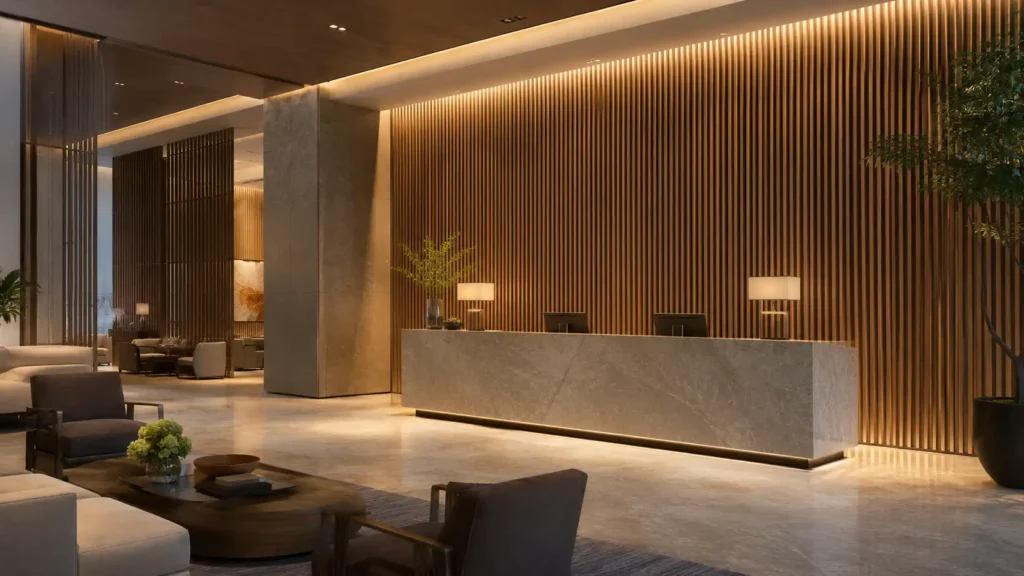
On the exterior, WPC handles cladding, facades, fences, and garden walls that face rain and sun. Inside, the same material becomes feature walls, fluted TV backdrops, slatted acoustic walls, and even surfaces in humid rooms where solid wood would swell.
The pattern we see from contractors is simple. They reach for WPC when a project needs the look of wood but cannot carry the maintenance of wood. A coastal hotel facade or a busy lobby wall gets the aesthetic without annual sealing and repainting.
In practice, the use cases split by setting. Hotels use WPC for lobby feature walls and facades that must look warm yet survive heavy traffic. Commercial spaces favor it for offices, retail fit-outs, and restaurants where downtime for maintenance is costly. Residential buyers choose it for accent walls, exteriors, and balconies. Across all three settings, the draw is the same: wood character without the wood upkeep.
Explore applications in depth: exterior wall panels, WPC fluted panels for TV walls, WPC wall panel living room ideas, wood acoustic panels, and WPC wall panels for bathrooms.
WPC vs PVC, Aluminum, Real Wood, and Fiber Cement
No single material wins every project. WPC’s advantage is balance. It offers a genuine wood look, strong moisture resistance, and a mid-range cost. Pure PVC is lighter and lower in cost but less wood-like. Aluminum and ACM are premium and non-combustible. Real wood is the most authentic but demands constant upkeep. Fiber cement is tough and durable but heavier and visually colder.
So how do you choose? Match the material to the constraint that matters most: fire code, budget, weight, or appearance. Then compare. The table below summarizes the trade-offs.
| Material | Lifespan | Maintenance | Wood look | Relative cost | Fire |
|---|---|---|---|---|---|
| WPC | 20–30 yrs | Low (wash only) | High | Mid | Class A available |
| PVC / vinyl | ~20 yrs | Low | Medium | Low | Varies |
| Aluminum / ACM | ~40 yrs | Low | Low | High | Non-combustible |
| Real wood | 10–15 yrs | High (seal/paint) | Highest | Mid–High | Combustible |
| Fiber cement | ~30 yrs | Medium | Medium | Mid | Non-combustible |
Indicative comparison; exact figures vary by product and climate.
WPC balances a real-wood appearance, low water uptake, and a mid-range price against PVC, aluminum, timber, and fiber cement. That balance makes it a default choice when buyers want the warmth of wood without the maintenance. North America held the largest WPC share at 51.7% in 2024, while Asia-Pacific grows fastest. The right pick still depends on the project’s fire, budget, and weight limits.
See the side-by-side breakdowns in WPC vs PVC vs aluminum composite, WPC vs ACM vs composite siding, WPC cladding vs real wood vs fiber cement, and PVC vs WPC exterior panels.
How Much Do WPC Wall Panels Cost?
WPC wall panels generally sit between vinyl/PVC and aluminum or fiber cement on installed cost. The total depends on board thickness, whether the panel is co-extruded, the surface finish, and your order volume. Rather than a single number, think in ranges and in cost over the panel’s 20–30 year life.
What pushes the price up or down? Thicker and solid boards cost more than thin hollow ones. A co-extruded UV cap adds cost but extends color life. Order size changes the unit economics. Larger volumes lower the per-panel price, which is where MOQ and factory-direct sourcing come in.
A cost-effective material is not the one with the lowest sticker price. It is the one with the lowest cost per year of service. That framing usually favors WPC over repeatedly refinished timber.
Order volume is the other lever. For trade buyers, larger quantities lower the per-square-meter price, and factory-direct sourcing removes the trading-company markup. Lead time and shipping belong in the total as well. A slightly higher unit price from a reliable factory often beats a cheaper quote that lands late or off-spec.
For real installed ranges in US dollars per square foot, see our “Cost Guide (2026)“.
How Do You Install and Maintain WPC Panels?
WPC wall panels install on a batten or furring subframe using clips or screws. They need little more than periodic washing, with no sealing, staining, or repainting. That low-upkeep reality is a big part of why specifiers choose the material for large facades and high-traffic interiors.
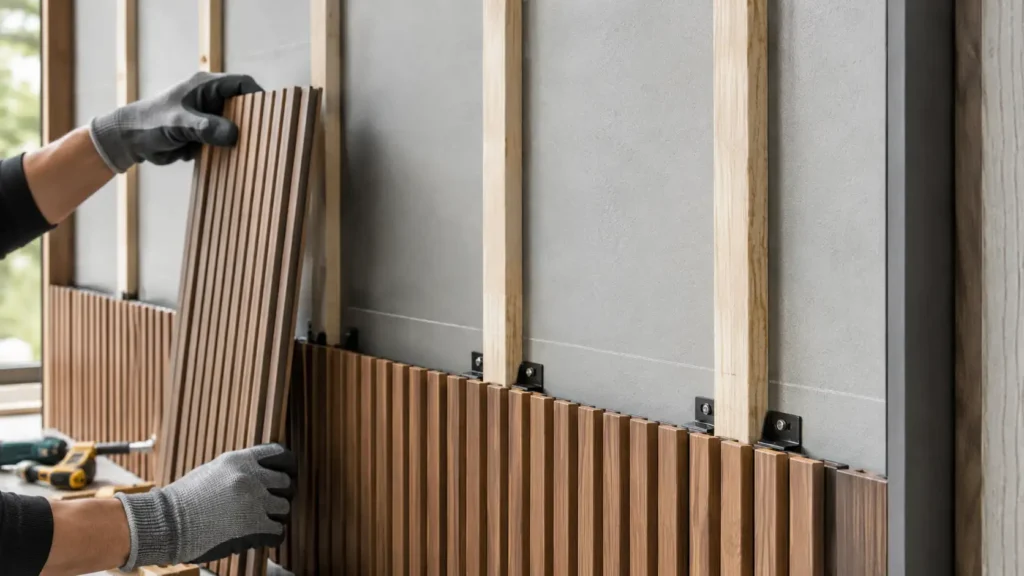
A few fundamentals decide whether an install lasts. Leave expansion gaps, because WPC moves with temperature. Use a level subframe and the right trims at corners and edges. Cut with standard woodworking tools and a fine blade for clean edges.
Maintenance is genuinely light. Most panels need only a wash with mild detergent and water a couple of times a year to stay fresh. That is a clear contrast with the annual cycle timber demands.
Step-by-step help lives in our WPC installation guide, plus guides to WPC wall panel accessories and trims and cleaning and maintaining WPC cladding.
How Do You Source WPC Panels and Choose a Manufacturer?
Source from a real manufacturer, not a trading company. Then verify production and certifications before you ever discuss price. Look for in-house R&D, production lines, and experience across decorative wall, floor, and ceiling systems. Confirm documented ISO 9001 and ISO 14001, CE marking, SGS or TÜV test reports, and REACH compliance. EU projects often also need EN 13986 conformity.
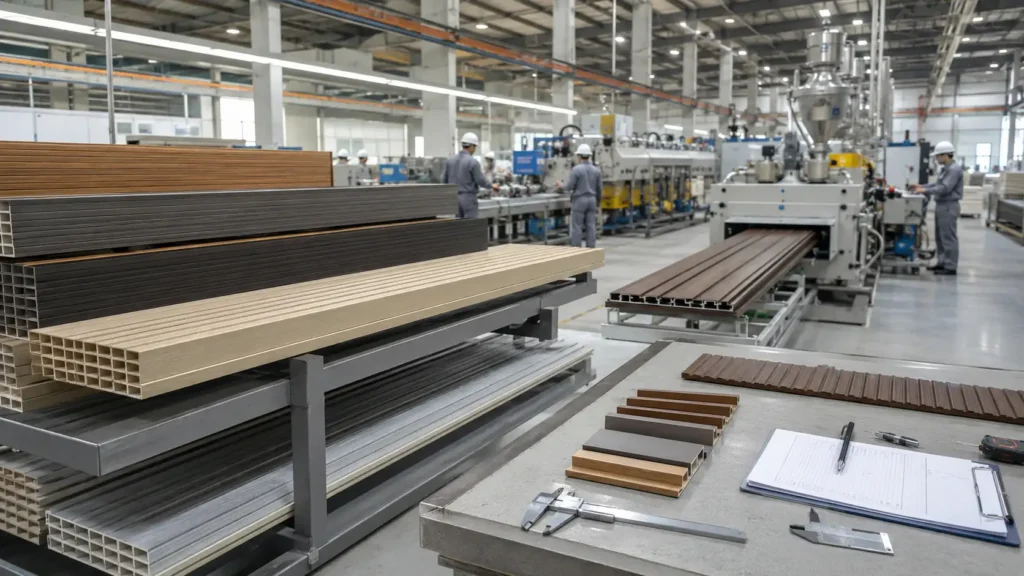
Here is the distinction most buyer guides skip. A trading company is not a factory. When you buy from the source manufacturer, you get traceable QC, consistent batches, real customization, and certificates tied to the actual production line. You are not relying on a middleman reselling whatever is cheapest that month. That traceability is what protects your project when an inspector asks for a fire report.
As a B2B decorative building materials brand and source manufacturer since 2012, WYRAX controls the full chain. We run it from raw-material formulation through extrusion and quality control to finished-goods shipment. That is how we hold spec consistency for distributors, contractors, importers, and OEM buyers across Europe, the Americas, Southeast Asia, and the Middle East.
A practical supplier checklist helps. Before you commit to a WPC panel supplier, verify the basics in writing:
| What to check | What to ask for | Why it matters |
|---|---|---|
| Manufacturer status | Factory walkthrough, production video, or production-line photos | Confirms you are dealing with the actual manufacturer, not only a trader |
| Certifications | ISO 9001, ISO 14001, CE, SGS/TÜV reports, fire test reports, REACH if needed | Proves the panel can meet your market’s compliance requirements |
| MOQ and pricing | Minimum order quantity and price breaks by volume | Shows whether the supplier fits your first order and scale-up plan |
| Lead time | Written production time plus shipping estimate | Prevents delays after deposit and helps plan container schedules |
| OEM/private label | Color, profile, packaging, and branding customization options | Confirms whether the supplier can support distributor or brand programs |
| Samples | Paid physical sample matched to the datasheet | Lets you check color, surface, profile, and dimensional tolerance before a full order |
| Export handling | Container loading process and export documentation support | Reduces shipment risk and avoids missing paperwork |
| Test report validity | Full report with test body, standard, date, and product match | Prevents relying on a certificate logo that may not apply to your exact panel |
Go deeper in our WPC wall panel manufacturer checklist, WPC panel certifications guide, WPC wall panel wholesale and MOQ guide, OEM and private label WPC wall panels guide, and WPC wall panels for hotels and commercial projects.
Sourcing for a project or your catalog? Fill out the contact form to request WYRAX samples and our full specification and certification sheet., and we will match a wall, floor, or ceiling material to your market’s fire and quality requirements.
Frequently Asked Questions
What is a WPC wall panel made of?
A WPC wall panel is made of roughly 40–70% wood fiber blended with 25–40% thermoplastic (PE, PP, or PVC), plus mineral filler and 1–5% additives, then extruded into a board. The polymer encapsulates the wood, which is what gives the panel its moisture resistance.
How long do WPC wall panels last?
WPC wall panels last 20–30 years on average. Interior installations frequently exceed 30 years, while exterior cladding typically lasts 15–20 years because of UV and weather exposure. Panel quality and climate are the biggest variables.
Are WPC wall panels waterproof?
WPC panels are highly moisture-resistant rather than fully waterproof. A quality panel absorbs 1.5% or less water after 24 hours and swells under 0.5%, so it will not rot, warp, or grow mold like solid wood. That makes them suitable for humid rooms and exteriors.
Are WPC wall panels fire resistant?
Yes, when made with flame-retardant additives. Quality panels can achieve EN 13501-1 B-s1,d0 in Europe or ASTM E84 Class A in North America, with a flame spread index of 25 or less. Always confirm the specific class and test report.
What certifications should WPC panels have for import?
Look for ISO 9001 and ISO 14001, CE marking, SGS or TÜV test reports, and REACH compliance. EU structural use often requires EN 13986, while North America references ASTM standards. Certificates should name the test body and tie to the production line.
What is the difference between WPC and SPC panels?
WPC (wood-plastic composite) blends wood fiber with thermoplastic for a warm, wood-like board. SPC (stone-plastic composite) blends limestone powder with PVC for a denser, more rigid product. WPC suits wall cladding and a wood aesthetic, while SPC is common for high-traffic flooring. WYRAX supports both categories within a broader decorative building materials portfolio.
Can WPC wall panels be repaired or repainted?
WPC wall panels rarely need painting, because the color runs through the board or sits in a co-extruded cap. Minor scratches on uncapped boards can be lightly sanded or heat-treated. Deeply damaged boards are usually replaced rather than refinished, which is quick on a clip-fixed system.
Conclusion
WPC wall panels have earned their place because they solve a real problem: the look of wood without the upkeep. The numbers back it up. You get a 20–30 year lifespan, ≤1.5% water absorption, available Class-A fire ratings, and a market growing about 8.6% a year toward USD 14.6 billion by 2031.
For buyers, the decision comes down to two things. Choose the right material for your project’s constraints. Then choose a real source manufacturer who can prove performance with certificates. Get both right and WPC delivers decades of low-maintenance service.
Ready for the next step? Compare materials in our WPC vs ACM vs composite siding guide, price it out with the WPC wall panel cost guide, or start with how to choose a WPC manufacturer and request WYRAX samples now!
About the author
Peter Smith, Marketing Specialist at WYRAX. Peter Smith is a marketing specialist at WYRAX, a B2B decorative building materials brand focused on wall, floor, and ceiling solutions for global distributors, contractors, importers, and OEM buyers. He writes for trade buyers who need clear material guidance, sourcing context, and project-ready specification information.
Sources
- Mordor Intelligence, Wood Plastic Composites (WPC) Market Size, Research Report & Share 2026–2031,https://www.mordorintelligence.com/industry-reports/wood-plastic-composites-wpc-market
- Grand View Research, Wood Plastics Composites Market Size, Share & Trends, https://www.grandviewresearch.com/industry-analysis/wood-plastic-composites-market
- ScienceDirect, Physical and Mechanical Properties of WPC Board from Sawdust and Recycled HDPE, https://www.sciencedirect.com/science/article/pii/S1877705817304228
- wpcspc, The Service Life of WPC Wall Panels: An In-depth Analysis, https://wpcspc.com/the-service-life-of-wpc-wall-panels-an-in-depth-analysis/
- AesthedgeWallPanel, WPC Wall Panel Quality Rating Standard: A Comprehensive Guide, https://aesthedgewallpanel.com/wpc-wall-panel-quality-rating-standard-a-comprehensive-guide/
- Latitude Interiors, Is WPC Panel Fire Resistant? What ASTM E84 and EN 13501-1 Really Say, https://www.latitude-interiors.com/is-wpc-panel-fire-resistant-what-astm-e84-and-en-13501-1-really-say/
- Necowood, WPC Certification Guide 2026, https://www.necowood.com/news/wpc-wall-panel-certification-guide.html
- USA Builders Depot, WPC Wall Panel: The Ultimate Guide to Wood Plastic Composite Panels, https://usabuildersdepot.com/blogs/news/wpc-wall-panel-the-ultimate-guide-to-wood-plastic-composite-panels