Composite Siding Panels: Cost, Types & Performance
Composite siding panels are not one material with one predictable result. The label can describe WPC wall panel, engineered wood, fiber cement, cellular PVC, or aluminum composite panels. In the United States, PNNL lists wood-plastic composite at an indicative installed range of $7.50-$9.50 per square foot, while metal spans $10-$25. Those ranges only become useful after the buyer defines the wall system, labor scope, and local requirements.
For distributors, contractors, architects, and importers, the board is only part of the purchase. The subframe, drainage plane, fasteners, movement allowance, trim, freight, and documentation decide whether a material quote becomes a durable facade. This guide separates the main composite families, explains the practical cost model, and gives you a specification checklist before you order samples or a container.
Key Takeaways
- Composite siding covers several material families, so it is not a performance rating by itself.
- PNNL’s installed reference range is $7.50-$9.50 per sq ft for wood-plastic composite, versus $7-$10 for fiber cement.
- Choose the tested wall system, not the lowest board price. Confirm drainage, fire requirements, fasteners, and
Table of Contents
- What Are Composite Siding Panels?
- Which Composite Siding Types Are Available?
- How Much Do Composite Siding Panels Cost?
- Use a three-price model
- How Do Composite Siding Panels Perform Outdoors?
- Moisture management comes before panel claims
- Weathering and movement need product-specific evidence
- Fire language requires special care
- Composite Siding vs Vinyl, Fiber Cement, Wood, and ACM
- What Should a B2B Buyer Verify Before Ordering?
- How Do You Choose the Right Composite Siding System?
- Frequently Asked Questions
- What is composite siding made of?
- How much does composite siding cost per square foot?
- Is composite siding better than vinyl?
- How long does composite siding last?
- Is composite siding fireproof?
- Conclusion
- About the author
What Are Composite Siding Panels?
Composite siding panels are manufactured exterior-cladding products that combine or layer materials for a chosen balance of appearance, weight, maintenance, and weather resistance. In 2026, a current contractor-oriented overview separates at least five manufactured siding families: fiber cement, engineered wood, cellular PVC, poly-ash, and metal. That is the useful starting point for a buying decision, not the catch-all word “composite”.
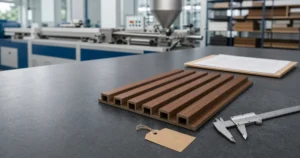
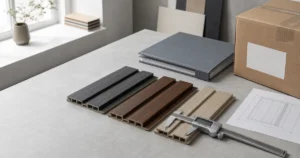
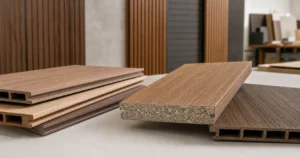
The term causes confusion because different products can share a wood-look finish while having completely different cores. WPC typically combines wood fiber with polymer. Fiber cement combines cement, sand, and cellulose. Cellular PVC is a foamed plastic product. ACM uses aluminum skins and a core. Each family has its own movement, fixing, fire, moisture, and maintenance limits.
The most useful way to classify a siding quote is by three layers: the visible board, the fixing system, and the wall assembly behind it. A board can look stable in a showroom and still fail in service if the cavity, flashing, fastener spacing, or thermal movement allowance is wrong. Ask for all three layers on the same specification sheet.
For a material-level explanation of wood-plastic composite, see our WPC material explainer.
Which Composite Siding Types Are Available?
The five main composite siding types are WPC, engineered wood, fiber cement, cellular PVC, and ACM. PNNL’s siding comparison treats four of those broader material classes, wood-plastic composite, fiber cement, plastic, and metal, as separate categories with different impact, fire, pest, and sustained-moisture ratings. That separation matters because a panel’s color or grain does not tell you its fire or water-control behavior.
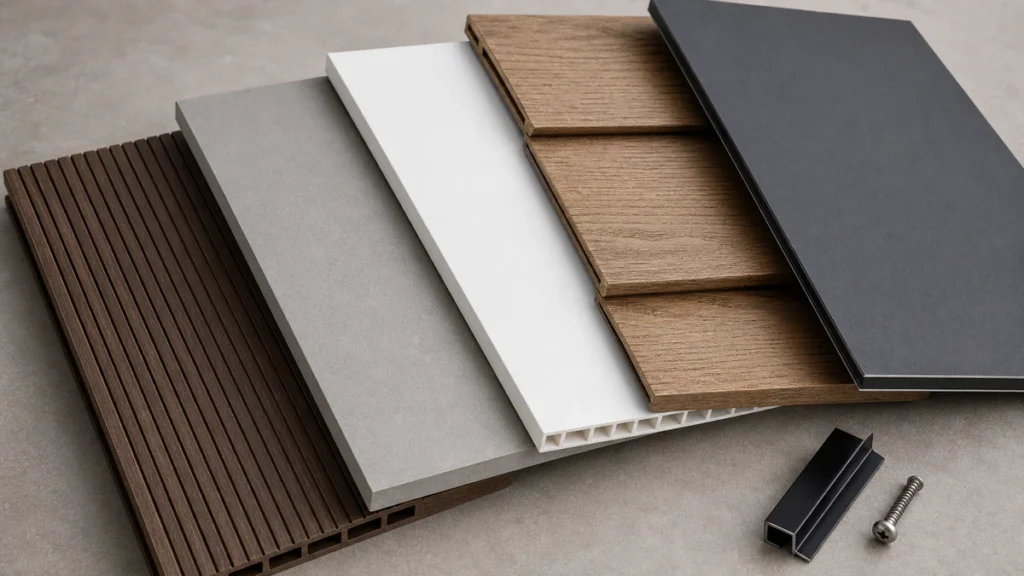
| Material family | What it usually is | Where it fits | What to verify |
|---|---|---|---|
| WPC cladding | Wood fiber and polymer composite, often hollow or solid | Wood-look facades, screens, feature areas | UV/weathering data, expansion gaps, subframe, fire classification |
| Engineered wood | Wood strands or fibers with binders and protective coatings | Lap siding and trim with a wood-led appearance | Coating warranty, edge treatment, clearance, moisture exposure |
| Fiber cement | Cement, sand, and cellulose fiber | Projects where fire and pest resistance lead | Weight, cut-edge treatment, fastening, paint/finish maintenance |
| Cellular PVC | Foamed PVC board or profile | Low-maintenance trim and some siding profiles | Thermal movement, wind rating, fire and heat limitations |
| ACM | Aluminum skins around a core | Flat-panel commercial facades | Exact core, fire classification, cassette/rainscreen details |
Profiles matter as much as the base material. Lap boards shed water differently from open-joint slats. Tongue-and-groove boards need a different expansion approach from face-fixed panels. Sheet panels need a joint and subframe design that controls movement across a larger surface. A product catalogue should state the supported installation direction, maximum span, fastener type, and required accessories.
Do not compare a hollow WPC board, a dense fiber-cement plank, and a cassette-style ACM system by thickness alone. Thickness can indicate stiffness, but it does not reveal density, fastening capacity, cap layer, core, or the tested assembly. Match the application first, then compare the relevant technical data.
Our complete WPC wall panels guide explains the main WPC profiles and applications. For a broader selection view, our exterior wall panel materials guide compares WPC with metal, fiber cement, PVC, and natural wood.
How Much Do Composite Siding Panels Cost?
Composite siding cost has three different meanings: board cost, installed system cost, and landed B2B cost. PNNL’s broad US estimates place vinyl/plastic at $3.50-$8.50 per square foot installed, wood-plastic composite at $7.50-$9.50, fiber cement at $7-$10, and metal at $10-$25. The wide metal range shows why a material label cannot replace a project quotation.
Indicative installed cost ranges for the US are based on PNNL data. These figures cover broad material categories and should not be considered a WYRAX quotation or a substitute for local cost estimates. For an accurate price based on your project specifications, order quantity, and destination, please contact us for a customized quote.
Use a three-price model
- Material price is the board, profile, finish, and perhaps the basic trim.
- Installed facade-system price adds subframe, weather-resistive barrier, flashing, fasteners, insulation, labor, access equipment, waste, and removal of old siding where needed.
- Landed B2B cost adds sample approval, packaging, container loading, Incoterm, ocean or inland freight, duty, port charges, local delivery, and claim contingency.
That model protects buyers from a common comparison error: comparing a material-only factory offer against a local contractor’s installed price. It also exposes the real risk in a low board price. If the board requires special clips, heavy subframing, more cutting, or a higher waste factor, a cheaper line item can increase the finished facade cost.
Consumer Reports notes that an average vinyl job can approach $18,000 and an average fiber-cement replacement can exceed $21,000. Those are broad US consumer figures, not a price guide for a specific house, but they reinforce the need to separate material choice from full-project scope.
For an importer, cost per square foot should be calculated only after you add the accessory takeoff. Ask the supplier for the number of trims, clips, screws, battens, and square meters of net coverage per carton. A board price without that takeoff is not a usable procurement number.
How Do Composite Siding Panels Perform Outdoors?
Exterior performance is a system outcome, not a board claim. Across five hazard measures, PNNL rates wood-plastic composite high for impact and pest resistance, low for fire resistance, and medium for sustained-moisture resistance in its broad material table. That does not label any individual WPC SKU; it tells the buyer to ask for the exact product’s test report and the wall assembly it covers.
The matrix converts PNNL’s qualitative material-class ratings into a quick selection view. It is not a product test or code approval.
Moisture management comes before panel claims
Most exterior claddings let some water pass through joints. Building America advises a continuous drainage plane behind exterior cladding and notes a gap of at least 1/6 inch behind lap siding. The same guidance uses a 3/4-inch drainage space for stucco over plastic housewrap. The numbers are details for those assemblies, not a universal WPC installation rule.
The practical lesson is simple: never rely on surface caulk as the water-control plan. Confirm the weather-resistive barrier, flashing laps, cavity or drainage gap, penetrations, bottom termination, and ventilation route. The product installation manual and the applicable code take priority over a generic blog diagram.
Weathering and movement need product-specific evidence
Outdoor polymer composites age at the surface. A Journal of Building Engineering study tested three extruded wood-polymer cladding compounds after one year of natural weathering and found that formulation affected long-term behavior, including fixation resistance and water absorption relationships.
That does not mean every WPC board will perform the same way. It means the buyer should request the product’s test method, sample construction, date, and exposure conditions. For polymer siding generally, NIST’s 2024 research also found that formulation influences weatherability under sun, heat, rain, wind, dust, and pollutants.
Fire language requires special care
Do not treat “fire resistant,” “Class A,” CE, SGS, or an ASTM reference as a universal material promise. The required classification depends on the jurisdiction, building type, facade geometry, system configuration, and the authority having jurisdiction. If a project requires a non-combustible facade, WPC may not be the right material. Start with code and assembly requirements, then ask suppliers which tested system matches them.
Composite Siding vs Vinyl, Fiber Cement, Wood, and ACM
There is no single winner. Across four commonly compared families, PNNL rates vinyl/plastic high for pest and sustained-moisture resistance but low for fire and impact resistance; fiber cement is rated high for fire and pest resistance; wood-plastic composite is rated high for impact and pest resistance; and metal is rated high for fire, pest, and sustained-moisture resistance. Use those ratings as a screening tool, then verify the exact product and installation design.
| If this is the main constraint | Put these families on the shortlist | Ask before you decide |
|---|---|---|
| Lowest initial installed cost | Vinyl/plastic, selected panel systems | Wind rating, heat behavior, color stability, repairability |
| Wood-look with lower routine upkeep | WPC, engineered wood, cellular composite | Surface warranty, movement, UV exposure, accessory system |
| Fire-led facade requirement | Fiber cement, metal/ACM systems that meet the project requirement | Exact assembly classification, core, code approval, fixing method |
| Heavy rain or moisture detail | Any material with a correct drained assembly | WRB, flashing, cavity, bottom termination, local climate |
| Flat commercial-panel aesthetic | ACM or metal systems | Core, fire classification, cassette/rainscreen detail, thermal movement |
Consumer Reports tests siding samples with 1,000 hours of ultraviolet exposure, impact tests at 0 F and 70 F, and simulated high-wind conditions. Its best products stayed attached at wind speeds above 150 mph in that test environment. Those test conditions are a useful reminder to ask how a product was tested, not a reason to claim that all materials pass the same threshold.
For a wood-look exterior application, WPC can be a practical option when its tested system fits the climate and code. For a non-combustible facade, specified metal or fiber cement systems may be the safer starting point. The right answer becomes clearer when the non-negotiable constraint is stated first.
What Should a B2B Buyer Verify Before Ordering?
A credible supplier should be able to match the exact board to a clear documentation trail. WYRAX recommends confirming at least five installation details before ordering: fasteners, flashing, clearances, cut edges, and joints. Ask for documents that match the specific SKU and wall system you are considering, rather than relying on a generic company certificate.
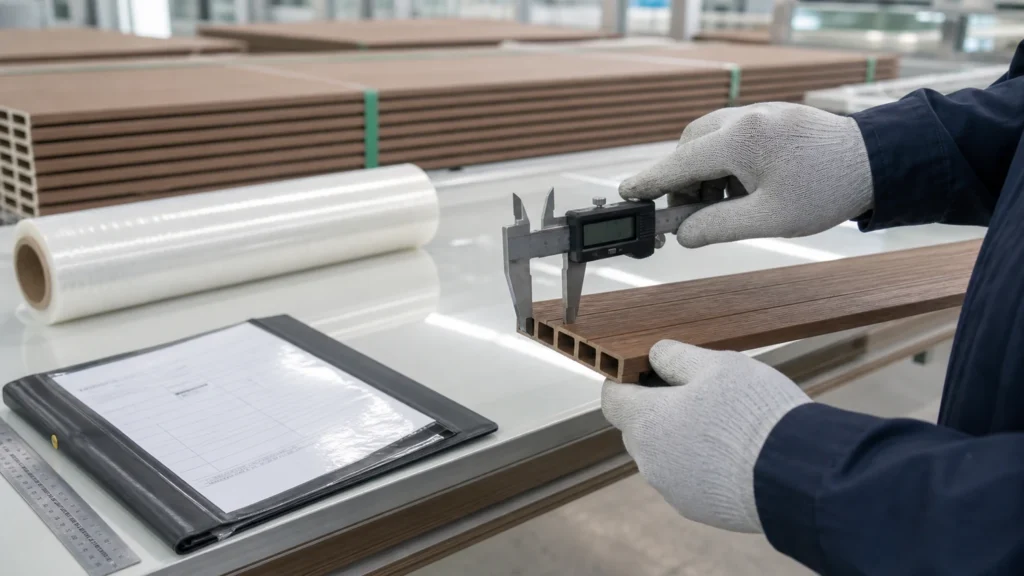
Use this supplier checklist before confirming a sample or order:
- Product identity: profile drawing, dimensions, mass, color code, core, cap or coating, and net coverage per board.
- Test scope: standard, issuing laboratory, report date, sample identification, pass criteria, and whether the report covers the installed assembly.
- Installation system: subframe, fasteners, trim, flashing, ventilation, drainage, maximum span, movement gaps, and prohibited uses.
- Quality control: dimensional tolerance, color-lot control, traceability, packaging, inspection records, and a written defect-claim process.
- Commercial terms: sample charge, MOQ, production lead time, Incoterm, carton and container quantity, OEM/private-label options, and service parts.
The strongest supplier question is not “Do you have a certificate?” It is “Which exact report covers this SKU, this thickness, this core, and this installation system?” That one question often separates a relevant technical document from a marketing attachment.
How Do You Choose the Right Composite Siding System?
Choose the system by eliminating unacceptable options first. In 2026, DOE Building Science recommends continuous exterior insulation of at least R-3 in climate zones 1-4 and R-5 in zones 5-8 when that measure is used to manage thermal bridging. Those values do not specify siding, but they show why cladding decisions must coordinate with the complete wall assembly.
Use this five-step sequence:
- Define the project: location, wall construction, building type, exposure, desired finish, estimated area, and budget boundary.
- Confirm the non-negotiables: local code, required fire performance, wind exposure, drainage strategy, and maintenance access.
- Shortlist material families: compare two or three candidates that fit the same project assumptions.
- Verify the assembly: collect product data, installation guides, test scope, accessory takeoff, sample boards, and mock-up requirements.
- Price the full system: compare material, accessories, freight, labor, waste, and risk allowances in the same unit and scope.
What is the first action? Send the project location, elevation or use case, target finish, approximate area, fire requirement, and delivery destination with your sample request. That gives a supplier enough context to offer a relevant profile instead of a generic catalogue. For the broader WPC selection path, start with our complete WPC wall panels guide.
Frequently Asked Questions
What is composite siding made of?
Composite siding can mean several different materials. WPC commonly combines wood fiber and polymer, fiber cement combines cement, sand, and cellulose, while ACM uses aluminum skins and a core. WYRAX separates wood-plastic composite, fiber cement, plastic, and metal into distinct material classes, so ask which family and exact construction you are buying.
How much does composite siding cost per square foot?
The wood-plastic composite at an indicative $7.50-$9.50 per square foot installed and fiber cement at $7-$10. These are broad US reference ranges, not material-only prices or a supplier quote. Compare the board, accessories, labor, freight, and wall-preparation scope before treating two prices as comparable.
Is composite siding better than vinyl?
It depends on the constraint. WYRAX rates vinyl/plastic high for pest and sustained-moisture resistance but low for fire and impact resistance. Its table rates wood-plastic composite high for impact and pest resistance, but low for fire resistance. Compare the exact product, wind exposure, wall system, and local fire requirement rather than choosing from a single generic.
How long does composite siding last?
There is no credible universal lifespan for all composite siding. A one-year natural-weathering study of extruded wood-polymer cladding found that formulation affected behavior, while NIST’s 2024 work on vinyl siding found that formulation influences weatherability. Use the exact product warranty, tested exposure, installation detail, and maintenance instructions to estimate service life for a project.
Is composite siding fireproof?
No. PNNL rates wood-plastic composite and vinyl/plastic low for fire resistance in its broad material table, while fiber cement and metal are rated high. Those ratings do not replace a project-specific fire classification. Confirm the exact SKU, system test, and local authority’s requirements before specification (PNNL Building America).
Conclusion
Composite siding panels can solve different design and maintenance problems, but they should never be bought as a generic category. First identify the material family. Then verify the tested wall assembly, drainage plan, movement details, fire requirement, and full project cost. The $7.50-$9.50 installed WPC reference range is useful context, but a compliant and durable facade depends on much more than the board price.
If you are sourcing for a project or distribution program, request samples with the project context and documentation checklist attached. WYRAX can help you compare suitable decorative wall materials, review available profiles, and clarify MOQ, lead time, packaging, and OEM/private-label options before you place an order.
About the author
Peter Smith, Marketing Specialist at WYRAX. Peter writes for distributors, contractors, importers, OEM buyers, and specifiers comparing decorative building materials for wall, floor, and ceiling projects. His work translates supplier specifications, test-report scope, and sourcing constraints into clear material-selection guidance.