What Is WPC? Wood-Plastic Composite Explained
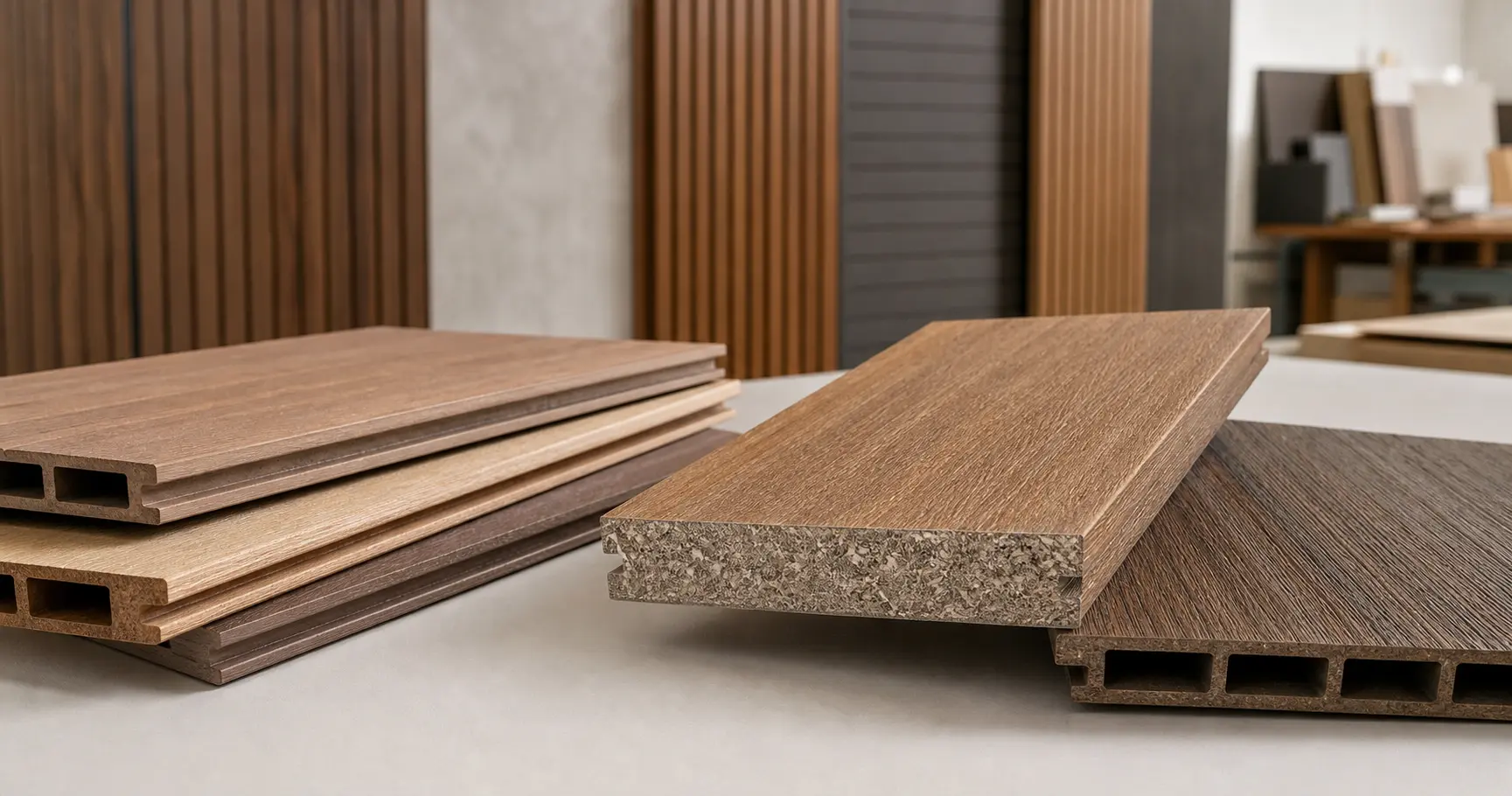
WPC is wood-plastic composite: an engineered material that combines wood fiber or sawdust with a plastic polymer binder. It is not solid timber and it is not pure plastic. Think of it as a hybrid material, built to keep some of wood’s texture while reducing the moisture, rot, and insect problems that come with natural wood.
The short answer matters because “WPC” gets used for many products: decking, fencing, cladding, interior wall panels, door frames, furniture boards, trims, and some automotive parts. If you are looking specifically at wall panels, start with our complete WPC wall panels guide. This article stays narrower: what WPC is as a material, how it is made, and where it makes sense.
Key Takeaways
- WPC means wood-plastic composite, a blend of wood fiber or sawdust and polymer.
- In 2026, Mordor Intelligence sizes the global WPC market at USD 9.63 billion, with 8.64% CAGR forecast through 2031.
- WPC is moisture-resistant and low-maintenance, but it expands with heat and is not the same as structural lumber.
Table of Contents
What Does WPC Stand For?
WPC stands for wood-plastic composite. A 2017 open-access paper in Procedia Engineering defines WPC as a composite material made from sawdust and plastic polymer bonding, tested under ASTM D7031 for physical and mechanical properties.
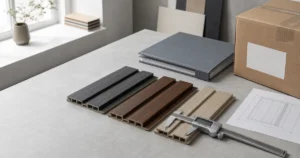
The name explains the material. Wood fiber gives WPC its grain, matte surface, and warm feel. Plastic binds the wood particles together and helps block moisture. Additives adjust color, UV resistance, fire behavior, processing, and surface stability.
You may also see WPC called wood polymer composite, plastic wood, composite wood, or wood-plastic board. Those terms are close, but not always identical. “Composite wood” can also describe MDF, plywood, particleboard, or other engineered wood products, so “wood-plastic composite” is the clearer term when plastic is part of the formulation.
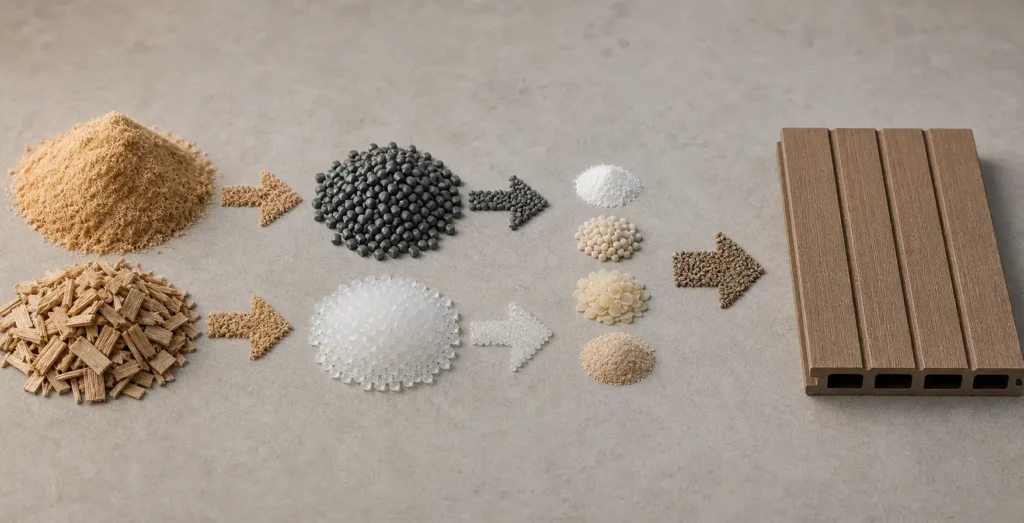
From a material-selection point of view, the important word is “composite.” WPC quality depends on formulation balance, extrusion control, and surface protection. Two products can both be called WPC and still behave very differently outdoors. What WPC Is Made From WPC combines wood fiber, polymer binder, mineral filler, and small performance additives. Wood fiber or sawdust Polymer HDPE, PE, PP, PVC Filler minerals Add itives Heat + pressure + extrusion turn the blend into a shaped board or profile. WPC is a formulation, not a single fixed recipe. Ratios vary by grade, polymer, and product use.
WPC Material Composition
WPC is made from wood fiber or sawdust, plastic polymer, mineral filler, and processing additives. In the 2017 ScienceDirect paper, the tested board used sengon sawdust and recycled HDPE plastic, showing how WPC can combine wood waste and plastic into one board material.
The wood portion is usually milled into flour, fiber, or fine sawdust. The polymer can be HDPE, PE, PP, PVC, or another thermoplastic, depending on whether the product needs outdoor toughness, indoor stability, fire performance, or price control.
Mineral fillers and additives do the quiet work. Calcium carbonate can improve stiffness and processing. Coupling agents help wood and plastic bond. Pigments set the color. UV packages slow fading. Lubricants help the material flow through a die during extrusion.
Factory note: in our experience, customers often ask whether WPC is “mostly wood” or “mostly plastic.” The better question is whether the formulation matches the use. Exterior cladding, interior fluted panels, decking, and furniture boards do not need the same balance.
For panel-specific grades, thicknesses, and profiles, see the WPC wall panel guide. That page handles product selection; this page explains the base material.
WPC Manufacturing Process
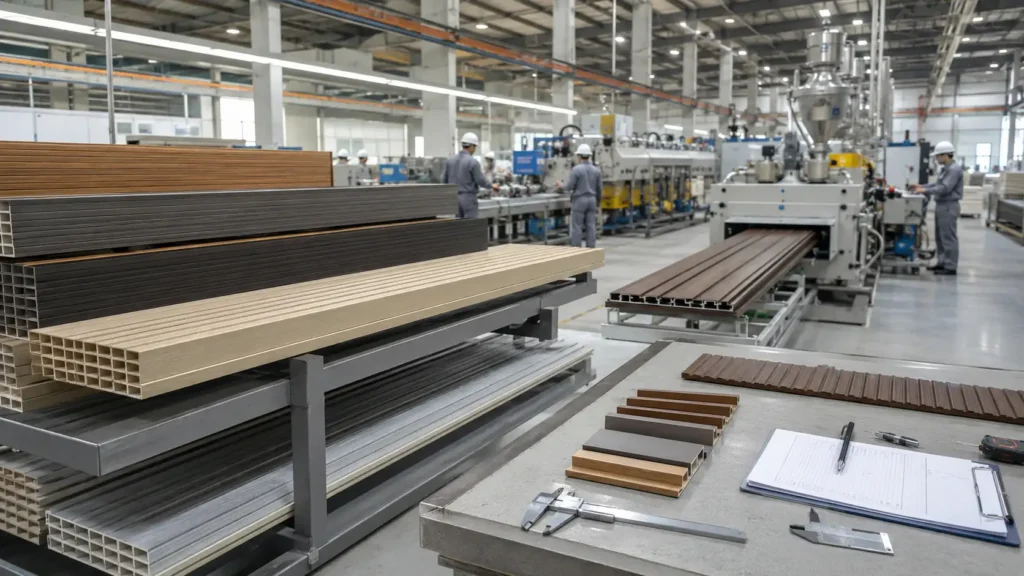
Extrusion is the dominant WPC production method. Mordor Intelligence reports that extrusion accounted for 70.36% of WPC processing technology in 2025, ahead of injection molding and other methods.
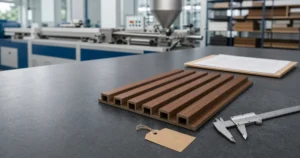
The process is simple in concept. Wood fiber is dried, blended with polymer and additives, heated until the plastic softens, then pushed through a shaped die. The profile is cooled, cut, embossed, brushed, or capped depending on the product.
Why does that matter? Because extrusion lets manufacturers make long, repeatable shapes: decking boards, cladding profiles, slat panels, trim strips, and hollow wall panels. Injection molding, by contrast, suits smaller or more complex shapes, such as molded components.
The biggest quality jump usually happens before the board exits the die. Moisture in wood fiber, poor mixing, or weak coupling can create swelling, brittleness, and uneven color later. A good surface finish cannot fully rescue a weak core.
WPC vs PVC and Real Wood
WPC differs from PVC because it contains wood fiber, and it differs from real wood because the fibers are bound in plastic rather than growing as continuous grain. ScienceDirect’s WPC board study reported bending strength around 40.49 MPa, shear strength around 27.35 MPa, tensile strength of 5.54 to 12.75 MPa, and a modulus of elasticity of 2113 to 3398 MPa.
That data points to the practical truth: WPC can be strong and stable for many non-structural uses, but it should not be treated exactly like timber. It lacks continuous grain, so it does not behave like a solid wood beam. It also expands and contracts with temperature because plastic is part of the matrix.
PVC is usually lighter and more plastic-looking. Real wood is easier to repair and can be structural in the right grade. WPC sits between them: more natural-looking than plain plastic, more moisture-resistant than wood, and less maintenance-heavy than painted timber.
| Material | What it is | Where it wins | Watch-outs |
|---|---|---|---|
| WPC | Wood fiber plus polymer | Moisture resistance, wood-look surface, low upkeep | Thermal movement, grade variation, not structural lumber |
| PVC | Plastic profile or sheet | Water resistance, light weight, low cost | Less natural feel, heat sensitivity, plastic appearance |
| Real wood | Natural timber | Strength, repairability, authentic grain | Rot, insects, repainting, swelling, cracking |
Use this as a material-level comparison. Installed cost and fire rating depend on the exact product.
For exterior material choices beyond WPC, compare broader options in our exterior wall panels guide.
WPC Benefits
WPC’s main benefits come from combining wood fiber with plastic: lower moisture uptake than natural wood, resistance to rot and insects, and less routine finishing. In the ScienceDirect WPC board study, the researchers found low moisture content, water absorption, and swelling in the tested WPC board.
The result is a material that fits damp, high-use, or low-maintenance settings. It does not need the same repainting and sealing cycle as many timber products. It also gives designers a wood-look surface without using a full solid-wood board.
Sustainability is more nuanced. WPC can use recycled plastic and wood waste, which is valuable. But the final composite can be harder to recycle than a single-material product, and low-grade boards can fail early. So the eco claim depends on the formulation, the supplier, the service life, and the local recycling route.
WPC Drawbacks
WPC has real limits. Mordor Intelligence lists temperature sensitivity and long-term wear or creep as restraints for the WPC market, and notes that WPC can have a coefficient of thermal expansion 3 to 5 times that of lumber.
In practical terms, WPC needs space to move. Installers should follow expansion-gap rules, especially outdoors or in hot climates. If a long profile is locked tightly at both ends, heat can make it bow or buckle.
There are other trade-offs. Uncapped boards can fade faster under UV exposure. Very cheap boards may have weak bonding, inconsistent color, or low impact resistance. Fire ratings also vary by formulation, so a WPC product should never be assumed suitable for high-rise facade use without test reports.
This is where buyers often blur material and product. “WPC” tells you the family. It does not tell you the exact fire rating, UV resistance, scratch resistance, formaldehyde level, or installation system.
WPC Applications
Building and construction is the biggest WPC application. Mordor Intelligence reports that building and construction accounted for 75.71% of WPC demand in 2025, with decking, fencing, cladding, and trim among the major uses.
Common WPC uses include:
- Decking boards and outdoor flooring
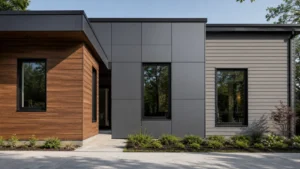
- Wall panels, cladding, and facade profiles
- Fencing, railing, pergolas, and garden features
- Interior fluted panels and decorative slats
- Door frames, trims, furniture boards, and molded components
- Some automotive interior parts where low weight matters
The same material family can serve different markets because the recipe changes. A decking board may prioritize abrasion and weather resistance. An interior wall panel may prioritize surface texture, color stability, and low odor. A molded automotive component may prioritize weight and shape precision.
For wall-specific applications, stay with the complete WPC wall panels guide. This article should not replace that buying guide; it should help readers understand the material before they compare products.
Is WPC Durable?
WPC can be durable, but the useful life depends on formulation, exposure, installation, and maintenance. One industry lifespan guide estimates WPC wall panels at 15 to 25 years on average, with indoor panels often reaching 20 to 25 years and outdoor panels commonly sitting around 15 to 20 years.
That is a better claim than saying WPC always lasts 30 years. Some premium capped outdoor boards may last longer, and some budget boards will not. Durability is a range, not a promise stamped onto every product.
Here is the practical checklist:
- For wet or outdoor areas, look for capped or co-extruded profiles.
- For sunny facades, ask for UV aging data and color-fade testing.
- For commercial projects, request fire, VOC, and dimensional-stability reports.
- For long runs, confirm expansion gaps and fastening rules before installation.
From the factory: the failures we see most often trace back to two causes: a low-grade board used in the wrong setting, or an installation that leaves no room for thermal movement. The material is forgiving, but it is not magic.
Frequently Asked Questions
What does WPC mean?
WPC means wood-plastic composite. It is a composite material made from wood fiber or sawdust and a plastic polymer binder. A 2017 ScienceDirect paper describes WPC as sawdust and plastic bonded into a board material and tested under ASTM D7031.
Is WPC real wood?
No. WPC contains wood fiber, but it is not solid wood. It is an engineered composite, so it can look and feel wood-like while behaving differently from timber. It has no continuous grain, and its performance depends on the polymer, additives, and manufacturing quality.
Is WPC the same as PVC?
No. PVC is a plastic polymer. WPC is a composite that may use PVC, PE, PP, or HDPE as the plastic part, but it also contains wood fiber. WPC usually feels more natural than plain PVC, while PVC is often lighter and simpler.
Is WPC waterproof?
WPC is better described as moisture-resistant, not fully waterproof. The plastic matrix helps reduce water uptake, but cut edges, joints, poor installation, or long exposure can still create swelling or surface problems. Always check the product’s water absorption data.
Is WPC good for outdoor use?
WPC can be good outdoors when the grade is designed for outdoor exposure. Look for UV protection, capped or co-extruded surfaces, suitable fire rating, and proper installation guidance. For facade and cladding decisions, use the WPC wall panels guide.
Conclusion
WPC is wood-plastic composite: an engineered blend of wood fiber and plastic polymer. It exists because wood looks good but struggles with moisture, insects, and upkeep, while plain plastic resists water but rarely feels natural.
The best way to judge WPC is by use case. As a material, it works well for many non-structural, low-maintenance, wood-look products. As a product, it still needs proof: formulation, test reports, fire rating, UV resistance, and correct installation.
If your next question is about panels, profiles, or project selection, continue with our WPC wall panels guide. If you are comparing facade families, the exterior wall panels guide is the cleaner next step.
About the author
Peter Smith, Marketing Specialist at WYRAX. Peter Smith is a marketing specialist at WYRAX, a B2B decorative building materials brand focused on wall, floor, and ceiling solutions for global distributors, contractors, importers, and OEM buyers. He writes for trade buyers who need clear material guidance, sourcing context, and project-ready specification information.
Sources
- Mordor Intelligence, Wood Plastic Composites (WPC) Market Size & Share Analysis – Growth Trends and Forecast (2026 – 2031),https://www.mordorintelligence.com/industry-reports/wood-plastic-composites-wpc-market
- ScienceDirect, Physical and Mechanical Properties of WPC Board from Sengon Sawdust and Recycled HDPE Plastichttps://www.sciencedirect.com/science/article/pii/S1877705817304228
- wpcspc, The Service Life of WPC Wall Panels: An In-depth Analysis https://wpcspc.com/the-service-life-of-wpc-wall-panels-an-in-depth-analysis/