Weatherproof Exterior Wall Cladding: Buyer’s Guide
Weatherproof exterior wall cladding is a system: finish, water-resistive barrier (WRB), drainage path, trims, fixings, movement allowance, and fire path. A broad U.S. reference range puts installed WPC at $7.50–$9.50 per square foot, useful only after the wall system and scope are set.
Buyers should ask which assembly can drain, dry, move, and meet code. Start with complete WPC wall panels guide for context.
Key Takeaways
- Treat siding as a layer that can leak, then provide a WRB, flashing, and drainage route.
- A broad U.S. reference range is $7.50–$9.50 per sq ft installed for wood-plastic composite; it is not a supplier quote.
- Specify the wall assembly first, then check the exact SKU, climate exposure, fire evidence, accessories, and sample quality.
Table of Contents
- What Makes Exterior Wall Cladding Weatherproof?
- Which Exterior Cladding Materials Handle Weather Best?
- Is WPC Cladding Weatherproof Enough for Exterior Walls?
- What Installation Details Prevent Water Damage?
- How Should You Choose Cladding by Climate?
- What Fire and Certification Checks Matter?
- How Should Importers Verify a Weatherproof Cladding Supplier?
- Frequently Asked Questions
- What is the most weatherproof exterior wall cladding?
- Is WPC cladding waterproof?
- What exterior cladding lasts longest outside?
- Do exterior wall panels need a rainscreen gap?
- What certificates should I ask a WPC cladding supplier for?
- Conclusion
- About the author
- Sources
What Makes Exterior Wall Cladding Weatherproof?
A weatherproof facade sheds bulk rain, then gives any water behind the face a continuous route to leave and dry. Exterior-siding guidance notes that fungi are inhibited below 20% wood moisture content and calls for a WRB plus a way to drain water that enters the assembly.
The panel, joints, and trims throw most water away. The cavity, WRB, flashing, penetrations, and base manage what reaches the backup plane. Caulk alone is not drainage. See our exterior wall panel options for the wider shortlist.
Weatherproof the assembly, then choose the finish. A premium board still fails if a window head, corner trim, screw penetration, or base traps water.
Which Exterior Cladding Materials Handle Weather Best?
No material is weatherproof on its own: choose the one whose exact system fits the site’s rain, UV, temperature, wind, salt, fire, and maintenance constraints. Broad U.S. installed references are $3.50–$8.50 per square foot for vinyl/plastic, $7–$10 for fiber cement, $7.50–$9.50 for WPC, $10–$25 for metal, and $11.50–$15.50 for masonry. These do not rank products; they show why material-only comparisons miss subframe, labor, detailing, and code scope.
| Material | Strong fit | Weatherproofing watchpoint | Fire/code check | Routine care |
|---|---|---|---|---|
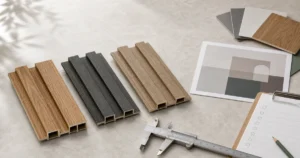
| Co-extruded WPC | Wood-look feature facades | Cavity, capped surface, movement gaps | Verify exact product and assembly | Wash; inspect joints and trims |
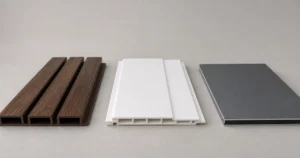
| Aluminum / ACM | Flat commercial facade systems | Core, joint design, coating, subframe | Verify core and tested assembly | Wash; inspect sealants and fixings |
| Fiber cement | Fire- or impact-led projects | Cut edges, coating, fixing | Confirm local classification | Recoat as the system requires |
| PVC / uPVC | Budget-sensitive applications | Heat movement and color limits | Check local approvals | Low routine upkeep |
| Real wood | Natural premium appearance | Species, coating, ventilation, drying | Combustibility and treatment | Maintain finish or accept weathering |
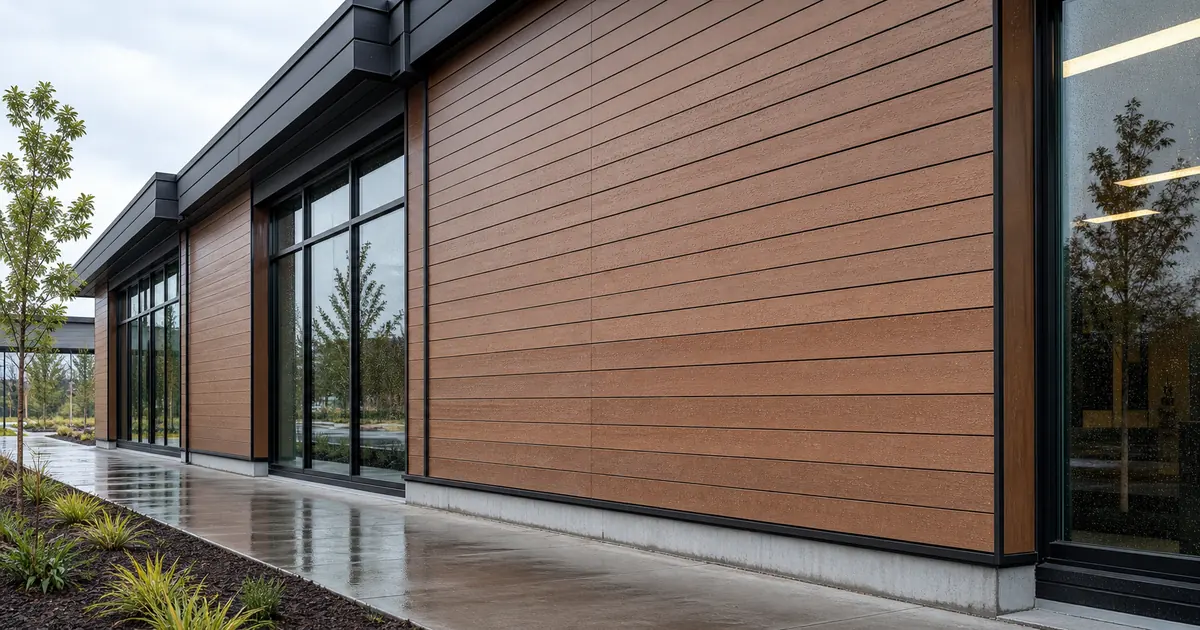
Metal and fiber cement often suit a fire-led brief. WPC suits a lower-upkeep wood look when its tested product and detail fit the site. Compare WPC, ACM, and composite siding.
Is WPC Cladding Weatherproof Enough for Exterior Walls?
Yes, WPC can be weatherproof enough for exterior walls when the exact exterior-grade profile, ventilated subframe, drainage, flashing, and movement details fit the site. EN 15534-5:2014 covers WPC cladding profiles and tiles, while ASTM D7032-21 covers WPC and plastic-lumber deck boards, treads, guards, and handrails rather than generic wall cladding. Those different scopes show why an exterior WPC claim must be tied to the exact profile, use, test report, and installation system.
It is water-resistant, not a waterproof skin. Request its section drawing, cap construction, weathering method, fixing schedule, span, trims, and expansion-gap instructions.
For hot, high-UV markets, do not select the lowest-cost uncapped board. Document the pigment, cap layer, weathering exposure, and movement allowance for the imported SKU. See how durable WPC is outdoors.
What Installation Details Prevent Water Damage?
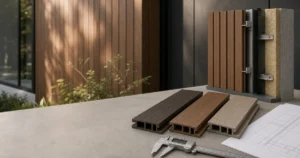
Prevent water damage with continuous WRB, opening and kickout flashing, a ventilated base, compatible screening, corrosion-resistant fixings, and the approved clearances. Reference examples use 1/4 inch behind stucco, 1/16 inch behind lap siding, and roughly 1/4 inch where a clear drainage gap is needed. These are not universal WPC dimensions, but they show that drainage space and flashing are engineered details, not optional accessories.
Confirm WRB continuity, opening and kickout flashing, a ventilated base, compatible screening, corrosion-resistant fixings, and approved clearances. The manual takes priority because profiles drain differently. Leaks usually start at windows, transitions, corners, cut edges, and sealed-but-undrained bases; keep accessories in the panel quotation.
How Should You Choose Cladding by Climate?
Choose cladding by the actual hazard, UV, salt, wind, freeze-thaw, rain, or flood, rather than by a single “outdoor” label. A UV Index of 8 or more is classed as very high to extreme, and a flood-resistance reference uses at least 72 hours of sustained contact as a criterion for materials in that setting.
- Coastal or humid: use a ventilated cavity and compatible corrosion-resistant fixings.
- Heavy rain: prioritize flashing, bottom drainage, and a continuous WRB.
- Hot or high UV: request ASTM G154-23 conditions, duration, and measured change; “UV tested” alone is not a result.
- Freeze-thaw or wildfire: preserve drying, avoid water traps, and start with the jurisdiction’s assembly requirement.
What Fire and Certification Checks Matter?
Ask for the exact test, product, result, assembly, issuing laboratory, and jurisdictional relevance before accepting a fire or certification claim. ASTM E84-25 reports flame-spread and smoke-developed indices for building materials under its test conditions, whereas NFPA 285 evaluates fire propagation in exterior wall assemblies containing combustible components.
Request the full report. Match its product identification, thickness, core or cap, date, method, and specimen to the offer. For Europe-facing projects, ask for applicable EN 13501 evidence. For a facade assembly, confirm the report covers the insulation, WRB, subframe, joints, and cladding. Use our WPC panel certifications guide.
How Should Importers Verify a Weatherproof Cladding Supplier?
Verify product evidence, installation evidence, and shipment evidence before committing to a container. An applicable ICC-ES report can govern fasteners, flashing, clearances, cut edges, and joints, so supplier review must connect the documents to the exact offered SKU.
| Check | Ask for | Why it matters |
|---|---|---|
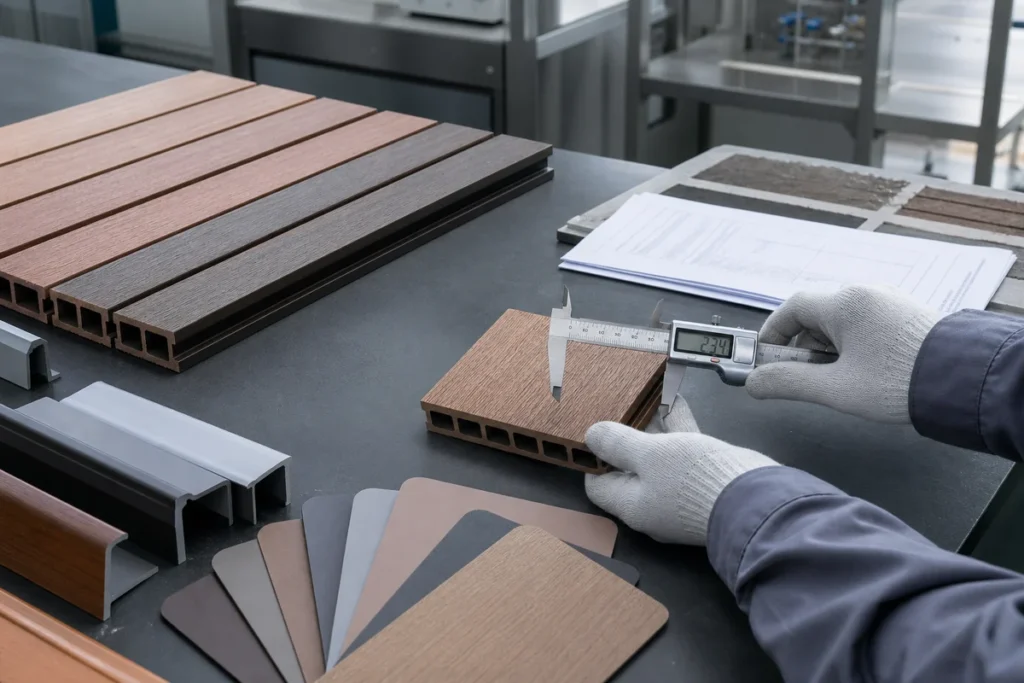
| Exact SKU | Profile drawing, dimensions, weight, cap/core, color code | Stops indoor or substituted product claims |
| Outdoor evidence | Weathering, water, heat-aging, and color data with method | Makes performance claims reviewable |
| Fire evidence | Full ASTM/EN report and assembly scope | Prevents product-only claims from being overread |
| Installation | Subframe, fixing, trims, spans, movement gaps, drainage | Turns the board into a workable system |
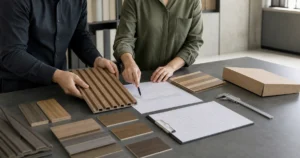
| Sample and QC | Paid sample, tolerance, color-lot control, inspection photos | Reduces container-level mismatch |
| Trade readiness | MOQ, lead time, Incoterm, packaging, loading plan | Makes the quote comparable |
Track rainfall, UV, salt, fire, wind, movement, subframe, trims, MOQ, sample approval, and packaging. Each row needs an owner and document; a verbal promise remains a procurement risk.
For the supplier due-diligence sequence, see our WPC manufacturer checklist and WPC wholesale and MOQ guide.
Frequently Asked Questions
Broad WPC cost and moisture references are useful inputs, but neither replaces local facade design. Define exposure and code requirements, then verify the product and installation evidence.
What is the most weatherproof exterior wall cladding?
There is no single winner. Metal, fiber cement, WPC, PVC, wood, and masonry can work when the wall drains and dries. A broad $3.50–$25 reference range shows that exposure, assembly, code, and maintenance decide the fit.
Is WPC cladding waterproof?
Exterior WPC is normally water-resistant, not waterproof. EN 15534-5:2014 gives cladding-profile context, but it does not certify every panel. Use an exterior-grade SKU with cavity, flashing, trim, fixing, and expansion instructions.
What exterior cladding lasts longest outside?
Service life depends on material, climate, maintenance, and installation. ASTM G154-23 is a weathering practice, not a lifespan guarantee. Compare documented exposure and measured changes, rather than accepting a generic years-in-service claim.
Do exterior wall panels need a rainscreen gap?
Many systems benefit from a drained cavity, but its dimension comes from the wall design and manual. Reference examples use 1/4 inch behind stucco, 1/16 inch behind lap siding, and roughly 1/4 inch where a clear gap can aid drainage.
What certificates should I ask a WPC cladding supplier for?
Ask for SKU-matched exterior data, weathering evidence, and the applicable fire report. ASTM E84-25 gives comparative flame-spread and smoke results; NFPA 285 is an exterior wall assembly test. For Europe-facing WPC, request EN 15534-5:2014 and EN 13501 evidence.
Conclusion
A broad $7.50–$9.50 WPC reference works only inside a full wall specification. Choose WRB, drainage, flashing, ventilation, movement, and compatible fixings first. Then select the finish for climate, fire path, and maintenance. Ask WYRAX for samples, SKU evidence, and accessories before production approval.
About the author
Peter Smith, Marketing Specialist at WYRAX. Peter writes for distributors, contractors, importers, OEM buyers, and specifiers sourcing decorative wall, floor, and ceiling materials. His work focuses on product documentation, sourcing decisions, and specification context for B2B projects.
Sources
- PNNL Building America Solution Center, Moisture-, Impact-, Fire-, and Pest-Resistant Exterior Siding, https://basc.pnnl.gov/resource-guides/moisture-impact-fire-and-pest-resistant-exterior-siding
- Building Science Corporation, BSD-030: Rain Control Theory https://buildingscience.com/documents/digests/bsd030-rain-control-theory
- ASTM International, ASTM D7032-21: Standard Specification for Establishing Performance Ratings for Wood-Plastic Composite and Plastic Lumber Deck Boards, Stair Treads, Guards, and Handrails, https://www.astm.org/d7032-21.html
- ASTM International, ASTM E84-25: Standard Test Method for Surface Burning Characteristics of Building Materials, https://www.astm.org/e0084-25.html
- ASTM International, ASTM G154-23: Standard Practice for Operating Fluorescent Ultraviolet Lamp Apparatus for Exposure of Materials, https://www.astm.org/g0154-23.html
- CEN, EN 15534-5:2014: Wood-plastic composites — Part 5: Specifications for cladding profiles and tiles, https://standards.iteh.ai/catalog/standards/cen/969b46b5-bd9c-419f-95f5-2bf6819b2d5f/en-15534-5-2014
- National Fire Protection Association, NFPA 285: Standard Fire Test Method for Evaluation of Fire Propagation Characteristics of Exterior Wall Assemblies Containing Combustible Components, https://www.nfpa.org/codes-and-standards/nfpa-285-standard-development/285
- U.S. Environmental Protection Agency, UV Index Scale, https://www.epa.gov/sunsafety/