WPC vs PVC vs Aluminum Composite Wall Panels (2026)
WPC, rigid PVC, and aluminum composite material can all cover a wall. They are not interchangeable systems. ASTM D3679-25 covers rigid PVC siding with requirements for expansion, impact, weathering, and wind load, while ACM and WPC need different product evidence. Start with the wall condition, then compare a documented system.
This guide compares material families, not unnamed products. It separates a decorative interior PVC panel from exterior siding and a designed ACM façade system. That distinction matters before any price request. For a broader material foundation, see the complete WPC wall-panel guide.
Key Takeaways
- PNNL lists WPC at $7.50-$9.50 per sq ft installed in a broad US category table.
- PVC, WPC, and ACM need different product documents, installation details, and fire evidence.
- Select the wall condition first. Then compare the exact panel system and quote scope.
Table of Contents
- What Separates WPC, PVC, and Aluminum Composite Panels?
- Which Material Fits a Quick Project Shortlist?
- What Changes When Fire and Code Drive the Project?
- How Do Moisture, Weathering, and Movement Change the Choice?
- Which Material Has the Better Impact, Finish, and Repair Path?
- Which System Is Easier to Specify and Install?
- How Should Buyers Compare Landed Cost and Procurement Risk?
- Which Buyer Should Choose WPC, PVC, or ACM?
- Frequently Asked Questions
- Is WPC better than PVC wall panels?
- Is aluminum composite panel the same as aluminum wall cladding?
- Is ACM non-combustible?
- Can PVC wall panels be used outside?
- What should an importer request before ordering?
- Select the Documented System, Not the Simplest Label
What Separates WPC, PVC, and Aluminum Composite Panels?
ASTM D3679-25 permits non-PVC layers below 20% by volume in rigid PVC siding. That limit shows why “PVC panel” is not a full specification. WPC is a wood-polymer profile, and ACM usually has aluminum skins plus a core. Each construction needs different documents.
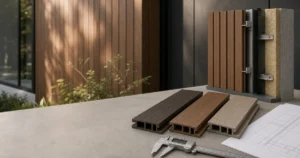
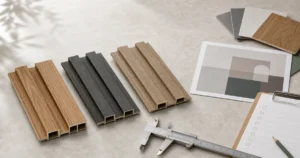
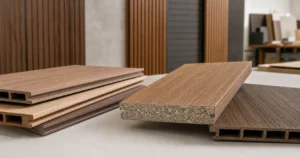
WPC combines wood fibre or flour with a thermoplastic matrix. Cap, profile, support spacing, fixing, colour, and exposure affect performance, so it is a material family rather than a specification.
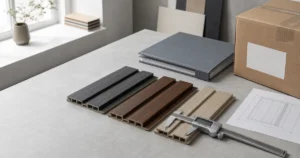
Rigid PVC can mean exterior siding, interior panels, foamed profiles, or laminated decorative products. Verify intended use: a bathroom panel is not automatically suitable for sun, wind, or a rainscreen.
ACM, also called ACP, commonly uses two aluminum skins and a core for flat planes and crisp reveals. The core is a mandatory procurement field; never infer it from a product photo.
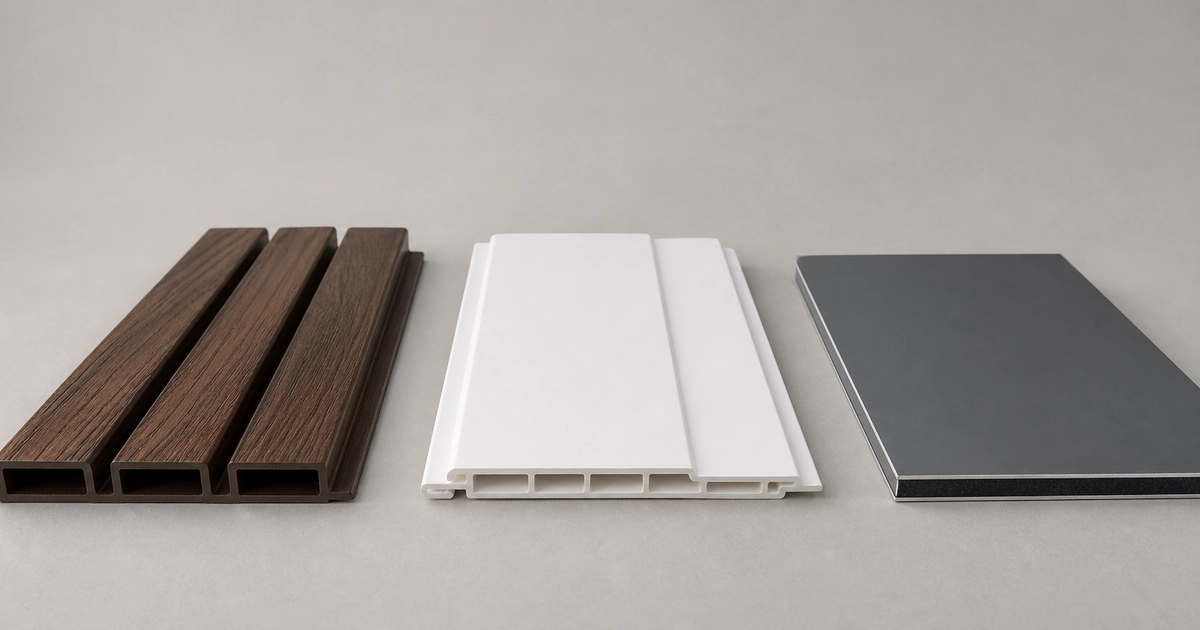
The useful comparison starts with the noun after the material name: WPC profile, PVC panel or siding, and ACM system. That small wording change forces a buyer to request construction, intended use, accessories, and installation instructions before comparing performance claims.
For material definitions and core terminology, review what WPC is made of and the guide to ACM core and panel construction.
Which Material Fits a Quick Project Shortlist?
PNNL’s broad US table lists plastic/vinyl/uPVC at $3.50-$8.50, WPC at $7.50-$9.50, and metal at $10-$25 per sq ft installed. It is a first screen, not a winner: metal is not ACM-specific, and plastic is not an interior-panel price.
| Decision factor | WPC | Rigid PVC | ACM / ACP |
|---|---|---|---|
| Usual visual language | Textured wood-look board or slat | Smooth or patterned panel | Flat metal plane with reveals |
| First-fit question | Does the profile and fixing suit the wall? | Is this panel intended for this exposure? | Does the core and system fit the façade requirement? |
| First evidence request | Profile, cap/formulation, movement and installation data | Layer stack, intended use, expansion and installation data | Core, skins, rail/cassette detail, fire and assembly evidence |
| Cost reference | PNNL WPC category: $7.50-$9.50 | PNNL plastic category: $3.50-$8.50 | PNNL metal category: $10-$25 |
PNNL category-level US installed-cost references, not current quotes or an ACM-specific pricing schedule.
WPC suits timber-like texture; suitable rigid PVC must match the location; ACM suits flat-panel architecture only after the core and system path are known. Wall condition and documentation can rule out any option.
For a documented way to compare full installed scopes, use the composite cladding cost framework.
What Changes When Fire and Code Drive the Project?
FM Global assessed seven ACM wall assemblies with a 16-ft parallel panel test. Its listed results changed with core, sheathing, WRB, insulation, and cavity. A PE-core assembly did not pass NFPA 285, while listed FR-core assemblies passed in stated configurations.
Separate panel composition, its test or classification, and the completed assembly’s required test or code path. A surface result, core class, and permitted façade assembly are not interchangeable.
ASTM D7032-21 is often cited for WPC. Its scope is exterior deck boards, stair treads, guards, and handrails. It identifies temperature and moisture, UV, freeze-thaw, biodeterioration, and fire as performance-test areas. It does not certify an unrelated wall cladding profile or convert it into a non-combustible system.
NIST’s 2024 vinyl-siding study found that its tested U-PVC formulations melted, flowed, and shrank during combustion. It did not grade all PVC products; it reinforces project-specific system review.
Project safeguard: Ask the authority having jurisdiction or a qualified façade professional which tested system applies before pricing materials. Do not buy a core claim, a generic certificate logo, or a single test result as if it were a project approval.
The fastest way to reduce quoting risk is to make fire evidence the first gate, not the last. A panel that cannot satisfy the required system path should leave the shortlist before colour, board price, or delivery timing are compared.
Use the fire and certification documents guide to prepare the question list for a supplier.
How Do Moisture, Weathering, and Movement Change the Choice?
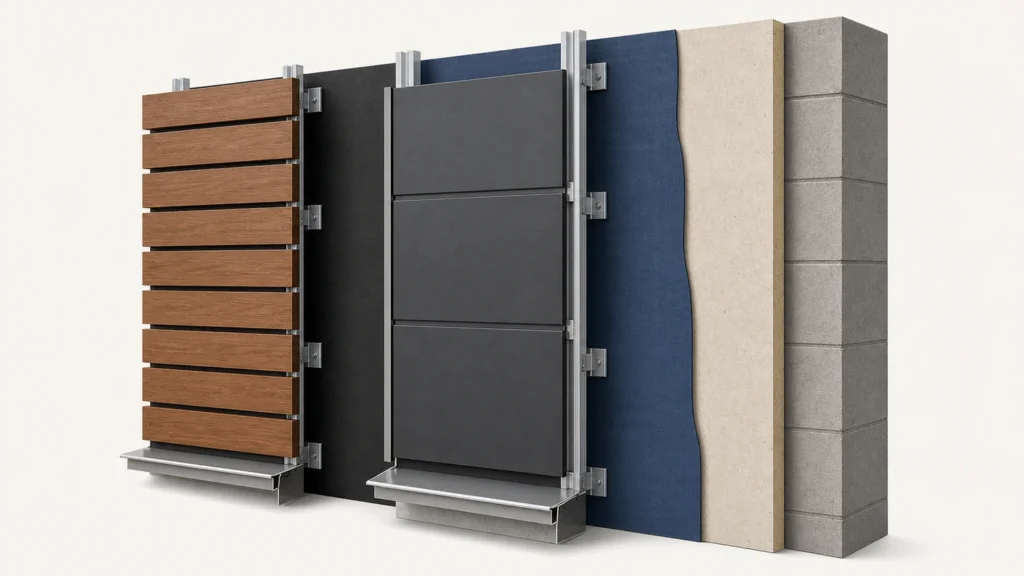
PNNL defines sustained moisture as at least 72 hours and rates WPC, plastic, and metal high for that category. The rating does not make cladding waterproof. A suitable system still needs drainage, a weather-resistive barrier, flashings, ventilation, compatible fasteners, and movement allowance.
Follow each product’s stated expansion gaps, support spacing, fasteners, joints, drainage, and flashing details. Sun exposure, colour, and wall design affect WPC, PVC, and ACM differently.
For exterior projects, compare the wider family of exterior wall-panel materials. Readers choosing a full façade system should also use the more specific WPC versus ACM versus composite-siding comparison.
Which Material Has the Better Impact, Finish, and Repair Path?
PNNL rates WPC high, metal medium-high, and plastic low for wind-borne-debris or hail impact. That is a category screen, not a product verdict. Thickness, profile geometry, backing, fasteners, support spacing, and installation can change results for a particular panel.
Use visual intent to shortlist WPC for timber texture, ACM for flat metal planes, and rigid PVC only when its finish, substrate, and use fit. Repairability needs its own review.
Confirm board release, later PVC finish availability, and any ACM matching-fabrication or component needs before approval.
Repair planning is an overlooked comparison factor. Make one spare-material and replacement-method line part of every quote. It converts an attractive sample into a maintainable system and exposes scope gaps before a purchase order is issued.
Which System Is Easier to Specify and Install?
ASTM D3679-25 requires rigid PVC siding to follow the manufacturer’s specific installation instructions. This does not make PVC hard to use. It shows that one generic fixing rule cannot serve every panel. The same product-to-system match is needed for WPC profiles and ACM.
WPC may use battens or clips; rigid PVC needs a specified substrate and movement allowance; ACM may use sheets, cassettes, or rails. Compare full detailing, not material price.
Before installation, match exposure, supports, fasteners, trims, joints, drainage, cleaning, repair, and installer capability. That is more useful than calling a material easy.
How Should Buyers Compare Landed Cost and Procurement Risk?
PNNL’s reference table spans $3.50-$8.50 for plastic, $7.50-$9.50 for WPC, and $10-$25 for metal per sq ft installed. Compare matched system scopes, not unit prices. PNNL notes that market conditions, availability, and project complexity can change actual cost.
For imports, include subframe, fasteners, trims, fabrication, cut loss, documents, packaging, freight, duties, clearance, and inland delivery. Compare matched quantities and sellable coverage.

Request an exact SKU, construction, test report, installation manual, sample, accessories, MOQ, lead time, Incoterm, container plan, warranty exclusions, and claim process.
For supplier-side due diligence, use the manufacturer verification checklist.
Which Buyer Should Choose WPC, PVC, or ACM?
No material family is a universal winner. Select by wall condition and proof first, then compare visual fit and commercial scope.
Interior wet-area or budget-led panel buyer: Consider rigid PVC only if intended use, substrate, cleaning instructions, and fire needs match the room.
Hotel, retail, or villa feature-wall buyer: Start with WPC for textured wood look, then check profile, exposure, fixing, movement, and replacement.
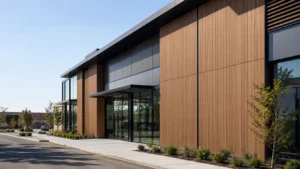
Flat commercial-façade buyer: Start with ACM for flat planes and reveals, then verify the core, skins, rail or cassette, and code path.
Distributor building a mixed range: Keep WPC, rigid PVC, and ACM offers separate with distinct data sheets and accessories. Do not sell them as generic “composite panel.”
Frequently Asked Questions
These answers show why labels cannot replace a system review. PNNL’s $3.50-$25 installed category range and FM Global’s seven ACM assemblies show how broad labels can obscure the decision.
Is WPC better than PVC wall panels?
PNNL lists WPC at $7.50-$9.50 and plastic/vinyl at $3.50-$8.50 per sq ft installed. Better depends on the exact product, exposure, installation method, fire evidence, finish, and repair path.
Is aluminum composite panel the same as aluminum wall cladding?
No. ACM uses aluminum skins around a core, whereas solid aluminum cladding is a different construction. Core, insulation, WRB, cavity, and other system components determine the evidence a project needs.
Is ACM non-combustible?
No blanket answer applies. FM Global listed one PE-core configuration that did not pass NFPA 285 and FR-core configurations that passed in stated assemblies. The panel core and installed system determine applicable evidence.
Can PVC wall panels be used outside?
Some rigid PVC siding or panels are exterior products, but an interior decorative panel is not automatically suitable. ASTM D3679-25 covers PVC siding weathering, expansion, and wind load. Verify the exact intended use and instructions.
What should an importer request before ordering?
Request an SKU drawing, construction details, sample, test reports, installation guide, accessory schedule, packing, MOQ, lead time, Incoterm, container plan, warranty exclusions, and defect-claim procedure. ACM system components can change performance.
Select the Documented System, Not the Simplest Label
Choose the documented system, not an easy material label. PNNL’s $3.50-$25 category range and FM Global’s seven ACM assemblies show why use, installation, and performance evidence come before price.
Request a matched documentation pack before you request a final price: the product drawing, installation instructions, evidence for the stated use, accessories, sample, quote scope, and delivery terms. That turns a material shortlist into a decision a contractor, distributor, importer, or specifier can defend.
About the author: Peter Smith is a marketing specialist at WYRAX who writes about decorative building-material sourcing and specification decisions. This editorial comparison requires SKU-level documentation and qualified project review before any code, fire, or installation claim is used for a specific project.