WPC vs ACM vs Composite Siding: Which Exterior Panel Fits?
WPC, ACM, and composite siding are often compared as if they were three interchangeable boards. They are not. WPC is a wood-polymer cladding family. ACM is a sandwich panel with aluminum skins and a core. “Composite siding” is a wider market label that can include engineered wood, fiber cement, cellular PVC, WPC, and more. The right choice starts with the project’s non-negotiables, not the preferred finish.
At WYRAX, we make and source decorative building materials for distributors, contractors, importers, and project teams. That means we see the real decision point: a material can look right in a sample box and still be wrong for the building, the code path, or the installation system. Use this guide to narrow the field, then verify the exact SKU and wall assembly with a qualified façade professional and the local authority.
Key Takeaways
- PNNL lists wood-plastic composite at $7.50-$9.50 per sq ft installed as a broad US reference.
- Choose ACM through its exact core and tested assembly, not its name alone.
- Choose WPC for a textured wood-look only when the wall system, exposure, and documentation fit.
For the wider material overview, begin with our complete WPC wall panels guide.
Table of Contents
- Are WPC, ACM, and Composite Siding the Same Thing?
- Which Material Fits Your First Decision Gate?
- How Do Rain, Moisture, and Thermal Movement Change the Choice?
- Which Material Handles Impact and Weather Exposure Better?
- Which Looks Better and Is Easier to Install?
- Which Has the Better Cost and Whole-Life Value?
- What Should a B2B Buyer Verify Before Ordering?
- Frequently Asked Questions
- Is WPC the same as composite siding?
- Is ACM non-combustible?
- Can WPC and ACM be used on the same exterior wall?
- Which exterior panel needs the least maintenance?
- What documents should an importer request?
- Conclusion: Choose the System That Clears All Three Gates
- About the author
Are WPC, ACM, and Composite Siding the Same Thing?
PNNL’s exterior-siding comparison treats wood-plastic composite, fiber cement, plastic, and metal as separate material classes because they do not share the same risk profile. WPC, ACM, and composite siding therefore describe overlapping but different product families. Treating them as synonyms can produce a poor specification before price or appearance is even discussed.
WPC means wood-plastic composite: a profile made from wood fibre or flour and polymer. It is usually chosen for a timber-like surface, low routine upkeep, and a board or slat format. The cap, formulation, profile geometry, substrate, fixing method, and exposure all affect how a particular product performs outdoors.
ACM means aluminum composite material. It normally uses two thin aluminum skins bonded to a core. It is commonly supplied as a flat panel for façades, interiors, and signage. The core is not a minor detail: a polyethylene, fire-retardant, or mineral core can change the project’s fire route and its permitted application. See our ACM panels explained guide for the core terminology.
“Composite siding” needs a follow-up question: what is it made of? Fine Homebuilding’s 2026 overview distinguishes manufactured siding families such as fiber cement, engineered wood, cellular PVC, poly-ash, and metal. A supplier should name the material construction and system rather than use “composite” as a stand-in for a technical specification.
The useful comparison is not “which panel wins?” It is “which material family can satisfy the project’s code, wall-system, and visual requirements at the same time?” That framing prevents an ACM price from being compared with a WPC board price or a generic siding claim from being mistaken for a test report.
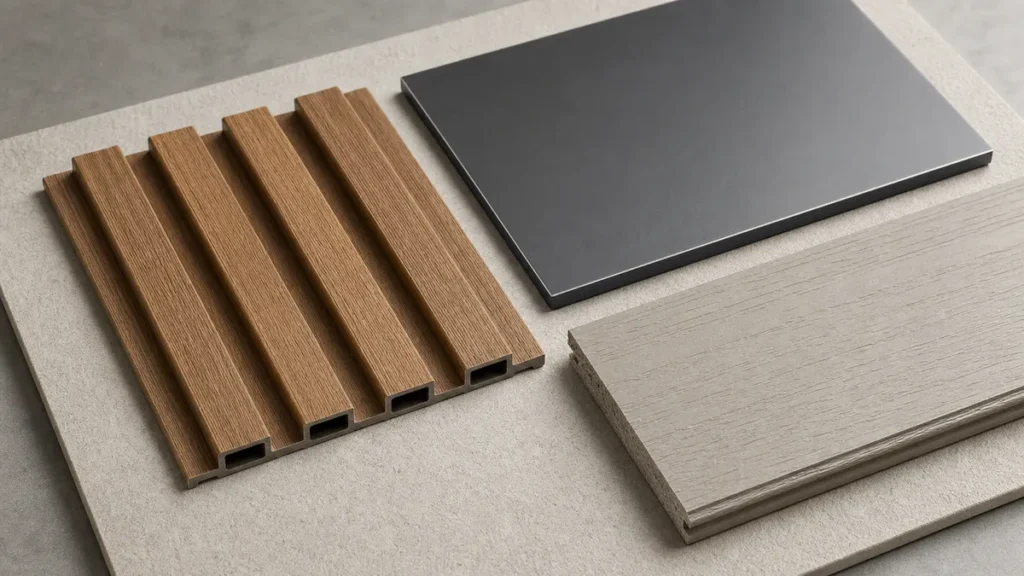
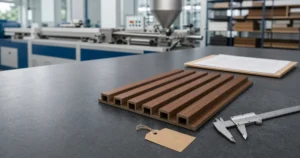
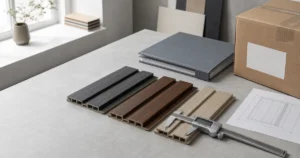
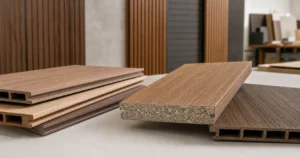
Illustrative material-family samples. Confirm the construction, profile, finish, and test documentation of the exact product you buy.
Which Material Fits Your First Decision Gate?
Generic wood-plastic composite low for fire resistance but high for impact and pest resistance, while it rates generic metal high for fire, pest, and sustained-moisture resistance. Those ratings are screening signals, not approval for a named panel. Your first gate is always local code and the tested assembly.
If a project is fire-led, begin with the authority having jurisdiction, the building type, height, location, and the required exterior-wall assembly. Then request the exact product report. Do not start with a colour chart. A surface flame-spread result, a reaction-to-fire class, and a full wall-assembly assessment answer different questions.
FM Global’s research illustrates why assembly scope matters. Its study evaluated seven ACM wall assemblies using different panel types, insulation, and weather-resistive barriers. Two assemblies with thermoplastic cores generated heat-release rates above 6 MW and flames above 25 feet within four minutes in the parallel-panel test. That does not describe every ACM product; it shows why core, insulation, WRB, cavity, and installation cannot be separated in a fire decision.
For a wood-look accent wall, WPC can be a strong candidate when its documentation and system fit the application. For a crisp, flat metal façade, ACM may fit the architectural intent, but the exact core and approved assembly remain decisive. For another composite-siding family, request the installation manual and product evidence before placing it in either category.
How Do Rain, Moisture, and Thermal Movement Change the Choice?
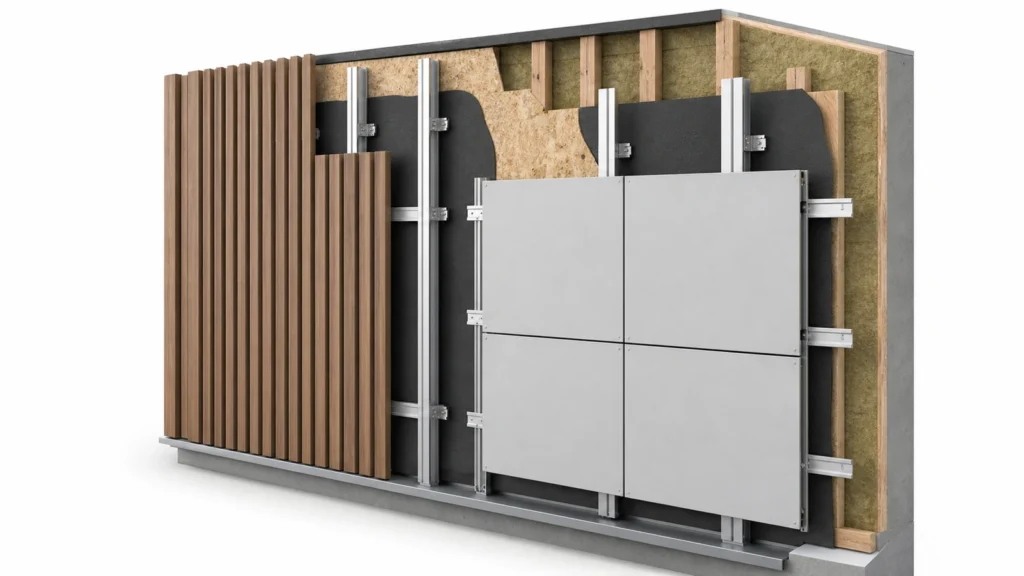
All siding should be assumed to leak during its service life and needs backside drainage and drying. Its guide describes a drainage gap, a weather-resistive barrier (WRB), and ventilated openings as parts of the water-control strategy. The better material is the one installed in a compatible wall system
WPC profiles need the manufacturer’s stated expansion allowance, fastening pattern, support spacing, and clearance details. ACM needs its own joint, cassette or rail, flashing, and thermal-movement design. Other composite siding systems have proprietary rules. Do not transfer a gap dimension from one material or one manual to another.
A1/16-inch drainage gap as a best-practice reference for lap siding in a specific context. It is not a universal WPC or ACM installation dimension. The U.S. Department of Energy’s building-science guidance makes the same larger point: the drainage plane sits behind exterior wall cladding to direct incidental water away from the wall cavity.
Before any exterior product is matched to an enquiry, confirm the wall substrate, climate and exposure, elevation design, profile direction, required documents, and destination. A product photograph alone cannot answer those questions. A named technical reviewer should verify the final system proposal before it becomes a project recommendation.
Which Material Handles Impact and Weather Exposure Better?
Consumer Reports subjects light-coloured siding samples to 1,000 hours of ultraviolet exposure and impact-tests at 0°F and 70°F. Its best tested products remained attached above simulated 150 mph wind. These are useful questions for a buyer, not proof that every WPC, ACM, or composite board will perform the same way.
WPC can offer a warmer, deeper wood-like texture than a printed flat sheet. It can also move with heat, and surface performance depends on the cap, colour, formulation, installation, and exposure. Ask for the test conditions, specimen identity, report date, and whether the report covers the installed system rather than a loose panel.
ACM offers flatness and colour uniformity, but flat metal panels can dent and their joints must allow for movement. A dark panel in strong sun and a pale panel in a mild climate are not the same duty. NIST’s 2024 research on vinyl siding similarly found that formulation and weathering conditions affect durability, which supports the wider procurement rule: composition and exposure matter more than a material label.
For a high-wind, hail, coastal, or intense-UV project, compare the applicable product test data, the fastener schedule, substrate, and local design requirement. A generic “weatherproof” claim is not enough.
Which Looks Better and Is Easier to Install?
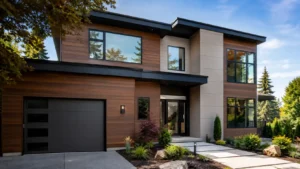
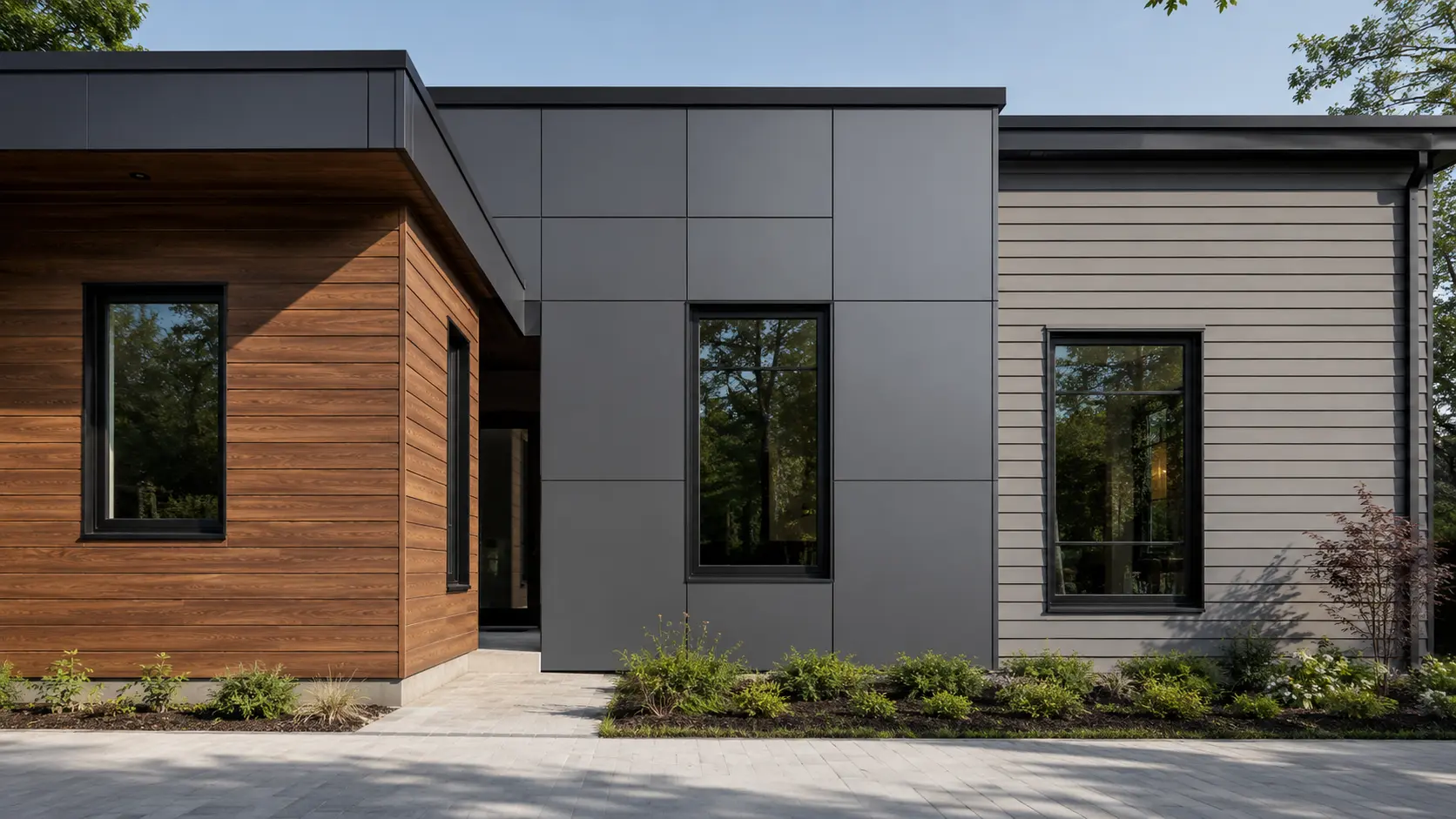
Choose WPC when the brief calls for a close-up timber effect, slatted rhythm, or warm feature zone. Choose ACM when it calls for broad, clean, flat planes and crisp reveals. A hybrid façade can use ACM as the main field and WPC as an entrance, balcony, or feature-wall accent. Each material still needs its own compatible support system and details.
Installation is not a contest between “easy” and “hard.” WPC boards may use clips or visible fasteners on battens. ACM may use routed cassettes, rails, or another engineered panel method. The wider composite-siding category follows its own manual. Use the exterior wall panel materials guide to shortlist the material family, then compare only systems that match the same wall condition.
For distributors, the safest sales language is exact and separate: “WPC cladding system,” “ACM with specified core,” or “named engineered siding system.” That gives the customer a clearer route to samples, data sheets, accessories, and a defensible quotation.
Which Has the Better Cost and Whole-Life Value?
Wood-plastic composite at $7.50-$9.50 per sq ft installed and metal at $10-$25 per sq ft installed in a broad US residential comparison. Wyrax warns that market conditions, material availability, and project complexity change actual pricing. Use the figures as directional reference data, never to issue a project quote.
The board price is only one line. Compare material, support system, fixings, WRB and flashing, fabrication, trims, cut loss, access equipment, labour, freight, duty, tax, sample approval, and the cost of remedial work if the scope was incomplete. For importers, add the agreed Incoterm, packaging, container utilisation, insurance, clearance, and inland delivery before dividing by sellable coverage.
Do not invent a universal service life or maintenance saving. Compare the manufacturer’s care instructions, warranty scope, exclusions, available repair method, coating or cap evidence, and project exposure. If two bids differ sharply, first ask whether both contain the same core, subframe, drainage detail, accessories, and installation responsibility.
For material categories and cost context, see the composite siding panels guide. A dedicated, dated cost guide should be used once a specification-matched data set is available.
What Should a B2B Buyer Verify Before Ordering?
Use this checklist before confirming a purchase order:
- Exact SKU, profile, dimensions, mass, finish, and colour code.
- WPC cap or formulation details, or ACM core type and aluminum-skin specification.
- Test report, issuing laboratory, standard, sample identity, issue date, and scope.
- Installation manual, subframe, fasteners, trims, drainage, movement, and prohibited uses.
- Approved sample, batch-control method, packaging, spare accessories, and defect-claim process.
- MOQ, production lead time, Incoterm, container plan, destination, warranty exclusions, and payment terms.
Frequently Asked Questions
Is WPC the same as composite siding?
No. Wood-plastic composite from fiber cement, plastic, and metal in its siding comparison. WPC is one composite family; “composite siding” can cover several different constructions. Ask for the exact material, profile, installation system, and test evidence before comparing performance.
Is ACM non-combustible?
It depends on the exact core and the tested wall assembly. FM Global evaluated seven different ACM assemblies, showing why panel, insulation, WRB, cavity, and installation all matter. Do not assume that the term ACM, a surface test, or one supplier’s core class confirms approval for another product or jurisdiction.
Can WPC and ACM be used on the same exterior wall?
Yes. A hybrid façade can use flat ACM for the main field and WPC for warmth at entries or feature zones. But PNNL’s guidance that all cladding needs drainage means both systems still need compatible WRB, flashing, cavity, fixing, and movement details. Do not let a visual concept override the wall-system design.
Which exterior panel needs the least maintenance?
There is no reliable one-word answer. Consumer Reports uses 1,000 hours of UV exposure in siding testing, while NIST notes that formulation and weathering conditions affect durability. Compare the exact cleaning instructions, finish or cap evidence, warranty exclusions, local exposure, and repair method rather than trusting a generic “maintenance-free” claim .
What documents should an importer request?
Request an exact SKU drawing, construction specification, sample, test reports, installation manual, packaging data, MOQ, lead time, Incoterm, and warranty exclusions. Where available, PNNL notes that an ICC-ES report can identify product-specific fasteners, flashing, clearances, cut edges, and joints, details that cannot be verified from a generic brochure.
Conclusion: Choose the System That Clears All Three Gates
Choose WPC when the project needs a textured wood-look and the exact system fits the wall, exposure, and documentation. Choose ACM when the project needs flat metal expression and the specified core and assembly meet the applicable requirements. Use the phrase “composite siding” only after the material family is defined.
Start with code and fire. Then verify drainage, movement, flashing, substrate, and fastening. Only then compare appearance, pricing, samples, logistics, and warranty scope. If you are sourcing for a project or distribution programme, request a WYRAX comparison pack with the project location, elevation, target finish, required documents, estimated quantity, and delivery destination. You can also review what WPC is made of before shortlisting products.
About the author
Peter Smith, Marketing Specialist at WYRAX. Peter writes for distributors, contractors, importers, OEM buyers, and specifiers comparing decorative building materials for wall, floor, and ceiling projects. His work translates supplier specifications, test-report scope, and sourcing constraints into clear material-selection guidance.