How to Choose a WPC Wall Panel Manufacturer
At an indicative installed cost of $7.50–$9.50 per square foot, wood-plastic composite appears competitive in PNNL’s 2026 US siding comparison. However, this figure is not a factory quote, so buyers should separate the panel price, complete wall-system cost, and landed cost when comparing suppliers.
Choose a WPC wall panel manufacturer by verifying a chain of evidence: the exact product, its intended use, the proof behind its claims, the approved sample, and the order controls. That process applies to WYRAX as well as any other supplier. Start with the complete WPC wall panels guide if you still need to define the product category.
Key Takeaways
- PNNL lists installed WPC at $7.50-$9.50 per sq ft, not as a factory price.
- Match each claim to the exact SKU, report scope, approved sample, and order term.
- Incoterms 2020 has 11 rules, so the delivery term belongs in every quote comparison.
Table of Contents
- What Must You Define Before Comparing a WPC Wall Panel Manufacturer?
- How Can You Verify Who Controls Production and Accountability?
- How Do You Match Certificates and Test Reports to the Exact SKU?
- How Should You Approve a Sample and QC Agreement?
- How Do You Compare Quotes on Matching Scope?
- How Does a Trial Order Prove Repeatability?
- What Mistakes Create the Most Supplier Risk?
- Frequently Asked Questions
- How can I tell whether a WPC supplier is a real manufacturer?
- Does ISO 9001 prove that a WPC wall panel is fire rated?
- What WPC test reports should I request?
- Is a CE mark enough to sell WPC wall panels in Europe?
- What should be in a WPC supplier quotation?
- Conclusion: Choose Evidence Before Price
- About the author
What Must You Define Before Comparing a WPC Wall Panel Manufacturer?
In 2026, the European Commission’s Construction Products Regulation FAQ lists seven basic requirements for construction works. That count does not create a universal WPC certificate checklist. It shows why your application, destination market, fire or code requirement, exposure, and exact profile must be clear before you ask a supplier for proof.
Write a short project brief before you request quotations. Record whether the panel is for interior or exterior use, the wall location, substrate, climate, visible elevation, profile, finish, quantity, deadline, and delivery point. If you are still comparing product families, review what WPC is and how it is specified first. Do not compare a fluted panel with an exterior cladding profile merely because both carry the WPC label.
For exterior work, define the system as well as the board. The shortlist may need a wider review of exterior wall-panel materials, then a focused comparison of facade material families. A supplier cannot provide meaningful fire, weathering, or installation evidence until the intended use is specific.
The useful first question is not, “Which factory is best?” It is, “What proof must the selected supplier provide for this exact panel and use?” That change prevents a catalogue claim from being mistaken for a project-ready specification.
How Can You Verify Who Controls Production and Accountability?
In 2026, the European Commission explains that a construction-product manufacturer takes responsibility for conformity with its declared performance when it affixes CE marking under the relevant CPR route. That is a useful accountability principle, but it does not identify who made every WPC panel offered worldwide.
Ask each bidder to identify the legal entity, registered address, facility location, product range, production role, and the person responsible for sample approval and shipment release. A trader can still coordinate a sound order, but the buyer should understand where production control sits and who resolves a mismatch.
Do not treat employee numbers, extrusion-line counts, export-country claims, marketplace badges, or a polished factory video as proof of product performance. Request a live walkthrough, a third-party inspection option, or records that connect the proposed profile to the facility’s actual process. Keep the answer with the supplier file.
How Do You Match Certificates and Test Reports to the Exact SKU?
In 2026, ASTM D7031 says WPC test methods must fit the product and application. A report matters only when its product identity, method, result, date, laboratory, and use scope match the panel you plan to buy. It does not extend automatically to another profile.
Separate five documents that are often confused: a quality-management certificate, a laboratory test report, a product or assembly evaluation, a Declaration of Performance, and a warranty. ISO 9001:2015 concerns a quality-management system. It is not, by itself, evidence of a fire class, weathering result, or approval for a particular facade application.
For a European cladding claim, ask whether the product is within a relevant harmonised route or European Technical Assessment, then request the matching Declaration of Performance. DIN EN 15534-5 describes specifications for WPC and NFC cladding profiles and tiles, but the current edition, national rules, and intended use still need checking before any compliance statement is made.
| Document | What it can show | What it cannot show alone |
|---|---|---|
| ISO 9001 certificate | A quality-management system | Fire, weathering, or project approval for one SKU |
| Test report | Result for the identified sample and method | Performance outside its sample or use scope |
| DoP or evaluation | Declared performance under its stated route | A blanket approval for every market or wall assembly |
| Warranty | Commercial remedy and exclusions | Independent technical evidence |
Use a claim-to-proof chain for every material statement: exact SKU, test method, issuing body, report date, sample or assembly scope, installation condition, then purchase-order reference. A missing link is a question to resolve, not a detail to assume away.
How Should You Approve a Sample and QC Agreement?
In 2026, Consumer Reports exposes light-coloured siding samples to 1,000 hours of ultraviolet light, checks impact at 0°F and 70°F, and records wind retention above simulated 150 mph for its best products. These conditions are buyer questions, not WPC acceptance criteria or results for your supplier’s panel.
Approve a sample only when both parties can identify it later. Put the SKU, profile, colour or finish code, dimensions, accessories, retained-sample owner, measurement method, packing reference, inspection stage, and claim route in writing. A pleasing unlabelled sample cannot control a production run.
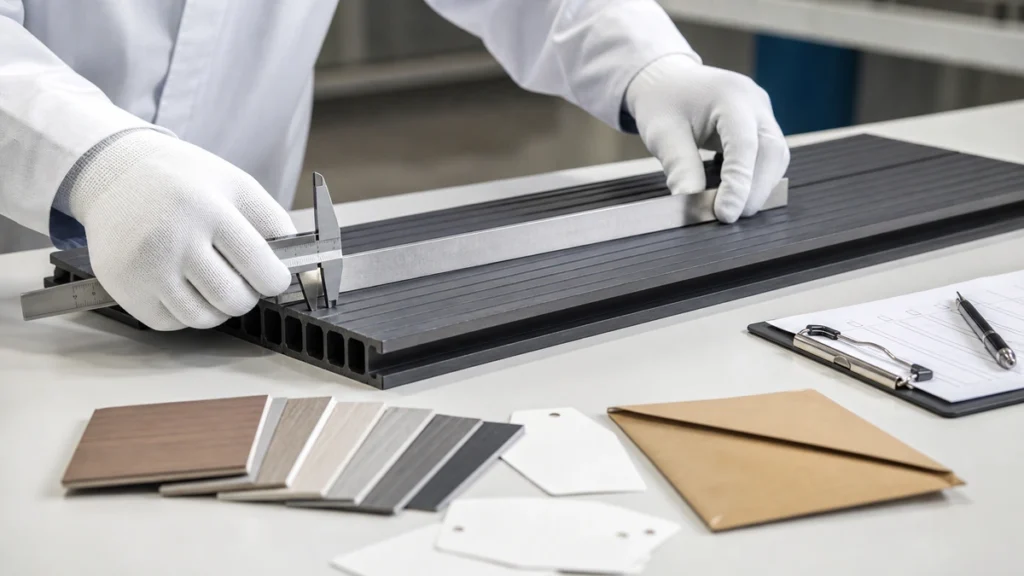
Illustrative QC scene. Use it as a reminder to keep a labelled sample and written measurement method, not as evidence of a specific factory inspection.
For exterior cladding, PNNL treats sustained moisture contact as at least 72 hours in its comparative siding table and advises buyers to consider drainage behind cladding. That does not establish a waterproof claim for a WPC board. It does show why panel evidence, accessories, and the wall detail must be reviewed together.
How Do You Compare Quotes on Matching Scope?
In 2026, the International Trade Administration says Incoterms 2020 contains 11 rules that allocate tasks, costs, and risks between seller and buyer. The named term belongs in a WPC quote, but it does not confirm panel quality, accessory completeness, or a supplier’s willingness to resolve a claim.
Compare every price on the same product and delivery basis. Put the exact SKU, sellable coverage, clips, trims, subframe, packaging, documents, MOQ, production window, Incoterm, delivery point, payment stages, warranty exclusions, and claim process in the same worksheet. Then you can compare the three price layers without confusing a board-only figure with an installed or landed cost.
Do not average broad market ranges into a buy price. PNNL’s same US comparison lists WPC at $7.50-$9.50 per sq ft installed, fibre cement at $7-$10, vinyl or plastic at $3.50-$8.50, and metal at $10-$25. Those categories can frame a conversation, but they cannot replace a dated, SKU-specific quotation.
How Does a Trial Order Prove Repeatability?
In 2026, PNNL uses 72 hours as a sustained-moisture threshold. Apply the same discipline to a first order: define the approved sample, inspection points, packing condition, documents, and remedy before production starts. A trial order must test repeatability, not simply approve a sample.
Use a staged path: document review, approved sample, pilot order, pre-shipment inspection, dispatch record, arrival inspection, then claim review. Decide who can stop shipment, how deviations are photographed, and how transit damage is separated from a production defect. If the agreement cannot answer those questions, it is not ready for volume.
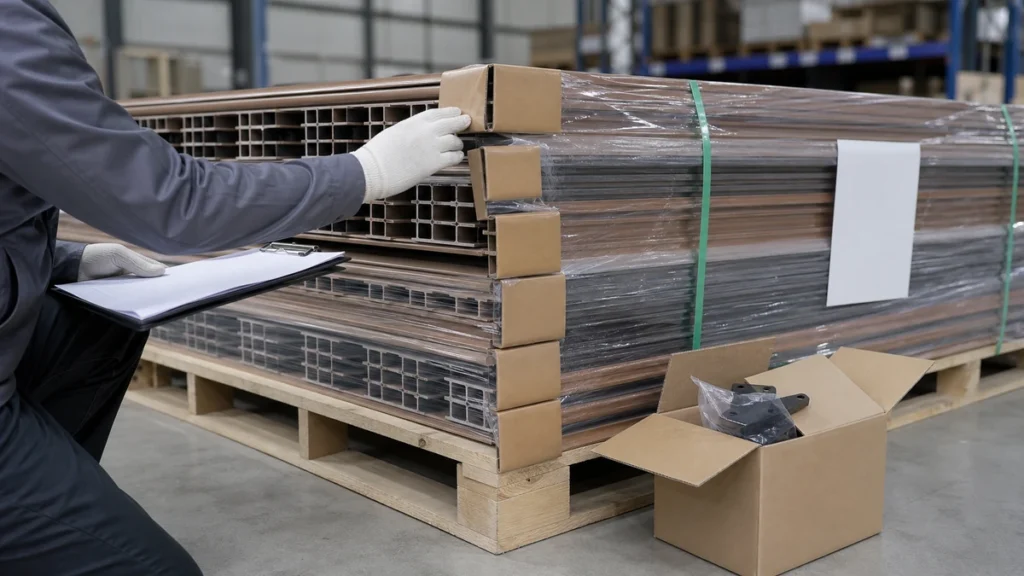
Illustrative packing scene. Confirm the actual SKU, corner protection, accessory packs, labels, and loading record for each shipment.
Avoid universal deposit percentages, defect allowances, lead times, warranty lengths, or inspection pass rates. They depend on the product, order size, route, contract, and supplier history. Clear terms beat a comforting but unsupported benchmark.
What Mistakes Create the Most Supplier Risk?
In 2026, Consumer Reports uses three distinct checks for siding performance: 1,000-hour UV exposure, impact at 0°F and 70°F, and simulated wind conditions. The lesson for importers is simple: one broad label such as “durable” cannot replace a claim matched to a specific method and scope.
The first mistake is treating a certificate logo as a product approval. The second is comparing a product-only price with a completed wall or landed-cost price. The third is approving an unlabelled sample. The fourth is calling every seller a manufacturer without confirming roles. The fifth is accepting a short quote that hides exclusions.
Keep your correction practical. Match evidence to the SKU, retain a labelled reference, compare the same scope, identify the accountable party, and write down what happens if production or delivery differs. Would you rather discover a gap in a spreadsheet or after a container arrives?
Frequently Asked Questions
In 2026, the European Commission’s CPR FAQ identifies seven basic requirements for construction works, and the International Trade Administration identifies 11 Incoterms 2020 rules. Those figures do not make selection automatic. They show why buyers need a technical evidence check and commercial scope check.
How can I tell whether a WPC supplier is a real manufacturer?
Use all six gates in this guide: project fit, accountability, product evidence, approved sample, matching quote, and trial-order controls. Ask for the legal entity, facility role, relevant production responsibility, and named release contact. A factory tour is useful, but it is only one part of a six-step verification process.
Does ISO 9001 prove that a WPC wall panel is fire rated?
No. ISO 9001:2015 defines quality-management-system requirements, while a fire claim needs evidence for the exact product or assembly, test method, result, use scope, and market. In 2026, ISO describes ISO 9001 as a system for establishing and improving quality management, not a panel fire classification.
What WPC test reports should I request?
Ask for the exact SKU drawing, applicable test reports, laboratory identity, method, date, sample or assembly scope, installation instructions, and a DoP or evaluation where relevant. Consumer Reports’ 1,000-hour UV test is a helpful prompt: check the reported conditions instead of treating a generic weathering label as proof.
Is a CE mark enough to sell WPC wall panels in Europe?
No generic answer is safe. The European Commission says CE marking under the CPR relates to declared performance assessed through an applicable harmonised standard or European Technical Assessment. The CPR FAQ lists seven basic construction-work requirements, so confirm the exact product, intended use, DoP, national rule, and design specification.
What should be in a WPC supplier quotation?
Include the SKU, sellable coverage, accessories, documents, sample or inspection reference, MOQ, production window, Incoterm, delivery point, payment terms, exclusions, and claim route. Incoterms 2020 has 11 rules, but a named term does not replace a complete quote or a product-specific quality agreement.
Conclusion: Choose Evidence Before Price
In 2026, PNNL’s $7.50-$9.50 installed WPC reference and the 11 Incoterms rules show why a price cannot settle sourcing. Check project fit, accountability, evidence, sample control, quotation scope, and trial-order terms.
Request a manufacturer verification pack only after you can state the application, market, exact profile, estimated quantity, required documents, Incoterm, and delivery point. Keep the checks in the purchase file. They will help you buy with less uncertainty and a clearer route to resolve problems.
Not sure which WPC wall panel best fits your project? Contact WYRAX for product recommendations, specification guidance, and a customized solution based on your application and purchasing requirements.
About the author
Peter Smith, Marketing Specialist at WYRAX. Peter writes for distributors, contractors, importers, OEM buyers, and specifiers sourcing decorative wall, floor, and ceiling materials. Before publication, a named technical reviewer should confirm any WYRAX product, test, or factory-process statement added to this article.