OEM & Private Label WPC Wall Panels: A Buyer’s Guide
In 2026, ISO reports more than one million ISO 9001 certificates across 189 countries. That reach explains why buyers often see an ISO certificate early in a sourcing conversation. It does not, however, prove that a private-label panel has the right profile, test scope, packaging, or claim for its market.
A WPC private-label launch needs a tighter chain. The branded SKU, approved sample, evidence file, production lot, carton artwork, and sales claim must describe the same product. If one link differs, pause the claim until the record catches up. Start with the complete WPC wall-panel guide if you still need to define the material and intended use.
Key Takeaways
- ISO reports 1 million+ ISO 9001 certificates in 189 countries, but a QMS is not a panel result.
- Lock the SKU, sample, test scope, artwork, QC plan, and order terms before production.
- Incoterms 2020 has 11 rules, yet none of them defines panel quality or claim scope.
Table of Contents
- What Do OEM, Private Label, White Label, and ODM Mean for WPC Panels?
- Why Is Branding Alone Not an OEM Specification?
- What Must a Private-Label WPC Specification Pack Include?
- How Do You Validate the Panel and Factory Before Production?
- Which Certificates and Test Reports Must Match a Branded SKU?
- What Must Be Agreed Before Releasing an OEM Order?
- When Is Private Label the Wrong Choice?
- How Do You Launch an OEM WPC Panel Line with Fewer Surprises?
- Frequently Asked Questions
- Is private label the same as OEM for WPC wall panels?
- What is a normal MOQ for private-label WPC panels?
- Does an ISO 9001 certificate prove a WPC panel is fire rated?
- Which Incoterm should I use for a WPC order?
- Can I copy a CARB or EPA formaldehyde claim to a WPC panel?
- Build a Defensible Private-Label Launch
- About the author
What Do OEM, Private Label, White Label, and ODM Mean for WPC Panels?
In 2026, ISO reports more than one million ISO 9001 certificates in 189 countries, showing how widely buyers encounter factory-quality terminology. Private label, white label, OEM, and ODM are not ISO terms. They are commercial labels, so the purchase order must define the actual product, branding, and approval duties.
For WPC panels, private label usually means an identified product sold under the buyer’s brand. White label usually means an existing supplier configuration sold to more than one brand. OEM can range from custom cartons to a controlled product build. ODM often means a supplier’s existing or supplier-led design adapted for the buyer.
Those terms are used loosely. Current supplier pages may list OEM, ODM, colour, embossing, packaging. Treat that language as an invitation to ask specific questions, not proof of a fixed service level.
Put the real scope in writing: profile, finish, colour reference, cap layer, accessories, packaging, artwork, territory, tooling, and any exclusivity. A buyer who only asks for a logo can receive a product that looks right in a photo but cannot be controlled after production starts.
Why Is Branding Alone Not an OEM Specification?
In 2019, ASTM listed its D7031 guide at eight pages and stated that users must choose test methods suitable for the product and application. That is the key point for private label: a logo does not make one WPC test result, installation method, or material construction apply to every branded panel.
A logo-only request leaves three gaps. First, the supplier can change the profile, thickness, colour, surface, or accessory set if the order lacks a defined SKU and approved sample. Second, a report can be misapplied when its test specimen or installation does not match the product being sold. Third, brand owners can repeat claims before confirming who approved the wording.
Use a six-link claim chain instead: product identity, evidence, approved sample, production lot, packaging and label, then market claim. It is a simple control method, but it prevents the most damaging mismatch: a compliant-looking carton attached to an unverified product configuration.
For the document-level distinction, see WPC panel certifications explained. It separates a quality-management certificate from a test report, product certification, CE route, and chemical declaration.
What Must a Private-Label WPC Specification Pack Include?
The public BS EN 15534 series lists Part 1 test methods and Part 5 specifications for WPC cladding profiles and tiles. That split shows why an OEM pack needs more than a visual reference. It must identify the panel and the intended application before anyone discusses a performance or market claim.
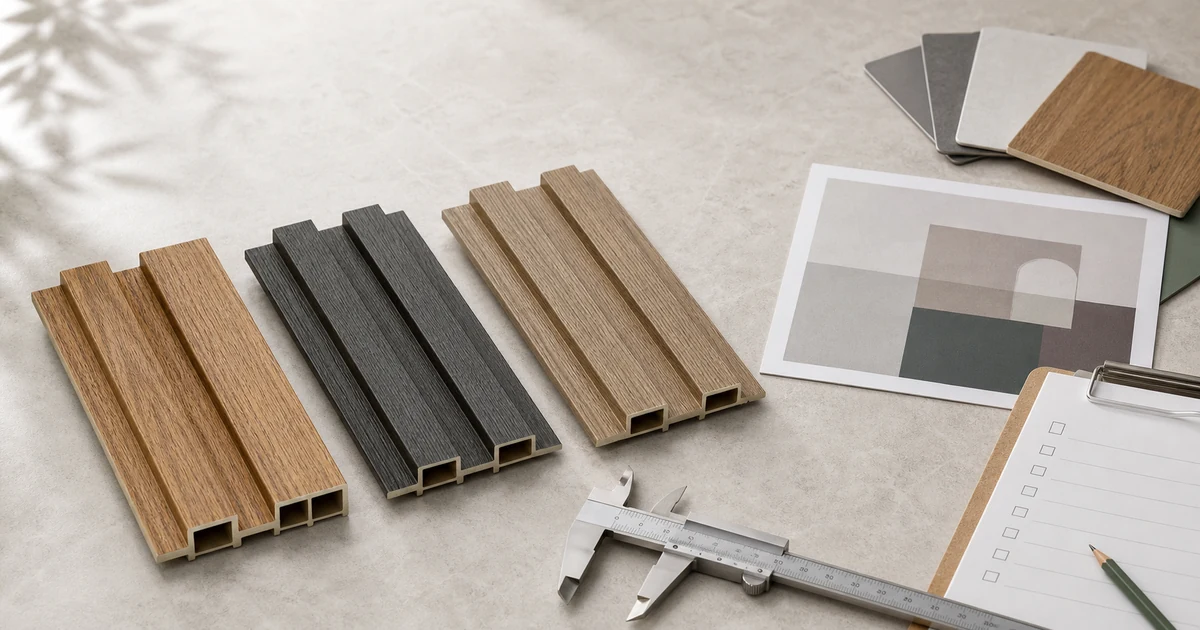
Start with product identity. Record the buyer SKU and factory SKU, profile drawing, dimensions, thickness, mass if relevant, material construction, surface or cap, colour reference, compatible trims, and intended indoor or outdoor application. Name the substrate and installation arrangement where they affect the product’s use.
Then add the evidence register. It should record the requested test method, issuing body, report date, specimen or SKU identity, scope, and any trigger that would require a new assessment. The pack should also state the target market, product claim, artwork revision, packing configuration, and exact label data.
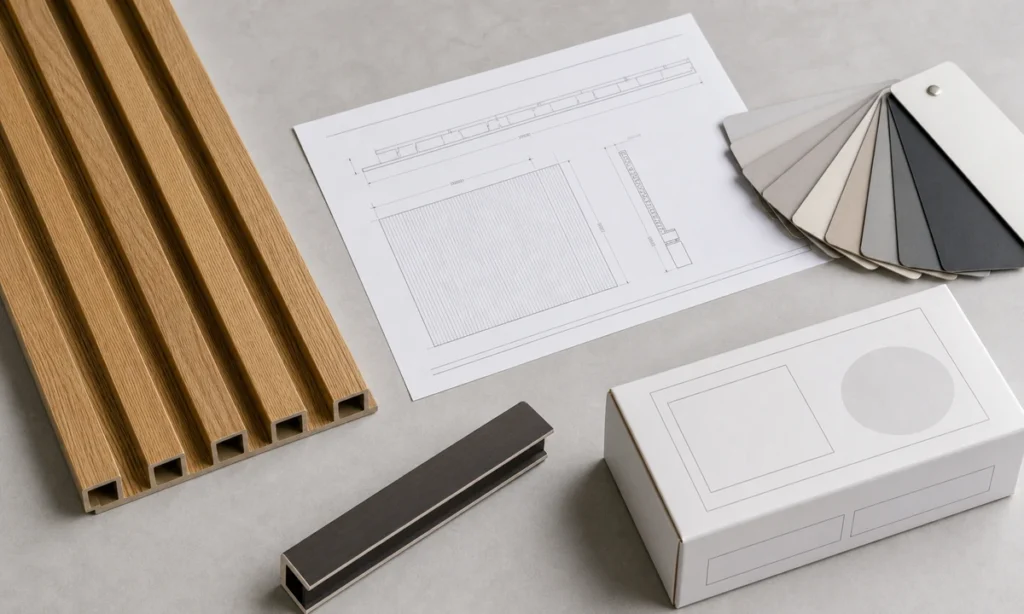
Brand ownership belongs in the same pack. WIPO’s trademark guidance explains that trademark use is controlled by the owner or can be licensed. Confirm artwork custody, approval rights, territory, and permitted reuse with qualified advice for the relevant jurisdiction.
For material terminology and formulation context, use the WPC material explainer before you approve an abbreviated supplier datasheet.
How Do You Validate the Panel and Factory Before Production?
ISO 2859-1:2026 is an 82-page third edition that sets out AQL-indexed sampling schemes for lot-by-lot inspection. It can help structure a production inspection plan. It cannot select an acceptable defect level, validate a vague SKU, or guarantee every panel in a shipment.
Use four gates. First, review the product drawing, proposed installation, test-report identity, and claims. Second, approve a labelled sample, finish, accessory, and packaging proof against the written specification. Third, confirm the production work order and artwork revision before the line runs. Fourth, inspect the lot against the agreed plan before release.
Keep one retained sample and one evidence register for each sellable configuration. A single unlabelled colour chip cannot settle a later disagreement about profile geometry, cap layer, carton artwork, or report scope. Traceability only works when both parties can identify the same physical reference.
Define what happens when the lot does not meet the agreed rule. The contract should name the release authority, evidence required for a concession, correction path, and timing for a claim. For wider supplier due diligence, use the WPC manufacturer checklist.
Buyer control note: Sample inspection reduces risk. It is not a substitute for a clear specification, current evidence, or a product-specific market review.
Which Certificates and Test Reports Must Match a Branded SKU?
ASTM E84 is a 10-minute comparative surface-burning test that uses a nominal 24-foot by 20-inch specimen. It is useful only within its defined conditions. ASTM also says flame-spread index alone does not define a material as noncombustible, so a private-label carton must not overstate the test.
Match every document to the exact product and claim. An ISO 9001 certificate concerns a factory quality-management system. A test report concerns the described specimen and method. A product certification concerns the named scheme. A CE route or declaration concerns declared performance under its applicable construction-product path. A chemical declaration addresses chemical information.
The difference matters most for building uses. UL Solutions’ exterior-wall testing overview lists distinct evaluations, including ASTM E84 surface burning, UL 263 or BS 476 fire resistance, NFPA 285 fire propagation, air, water, and structural testing. One document cannot automatically answer every wall-system question.
The European Commission says a Declaration of Performance and CE marking are required for construction products covered by a harmonised European standard or issued a European Technical Assessment. That is not a generic European-quality badge. Confirm the product route, intended use, and market requirement before using a CE claim.
What Must Be Agreed Before Releasing an OEM Order?
In 2026, the International Trade Administration says Incoterms 2020 contains 11 rules that allocate tasks, costs, and risks between seller and buyer. That clarity matters for WPC freight and documents. It still does not identify the panel, settle a defect rule, or validate the claim on its carton.
Release an OEM order only after the documents agree on product, quantity, permitted tolerances, accessory set, approved-sample reference, artwork revision, packing, inspection point, delivery term, payment stages, and claim process. Make the named place part of the Incoterm. “FOB” without the agreed port still leaves room for dispute.
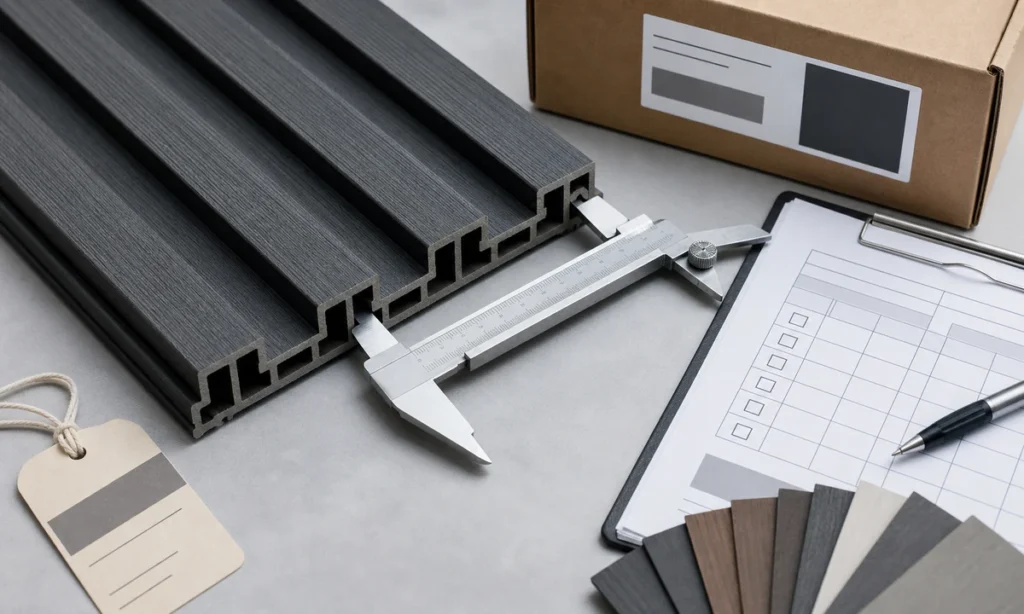
Add tooling ownership, maintenance, storage, permitted reuse, and end-of-programme handling when custom tooling is involved. Compare like-for-like price scopes as well. The composite cladding cost guide explains why material-only, landed, and installed prices cannot be treated as the same figure.
When Is Private Label the Wrong Choice?
In 2026, the U.S. EPA identifies three regulated composite-wood groups under TSCA Title VI: hardwood plywood, medium-density fiberboard, and particleboard. That narrow list is a reminder that material labels are not compliance answers. Do not copy an emissions claim to a WPC panel without checking the construction and market rule.
Private label is a poor fit when demand is too uncertain for dedicated packaging or tooling, the buyer cannot approve a representative sample, or a project depends on a known installed system whose technical path cannot be replicated. A named existing system may be safer than a new branded substitution in a code-critical application.
Where a project requires a different facade family, compare the exact core, assembly, and fire route in ACM panels explained rather than treating every decorative panel as interchangeable.
The better choice can be a standard, well-documented configuration with a limited branding scope. Customise only after the buyer can show why a unique profile, colour, package, or tooling arrangement has enough repeat demand to justify the operational risk.
For EU articles, ECHA says suppliers must provide safe-use information to customers when a Candidate List substance exceeds 0.1% by weight. That duty is another reason to define the product and its supply-chain information before launch.
How Do You Launch an OEM WPC Panel Line with Fewer Surprises?
ECHA’s 0.1% by weight SVHC communication threshold makes a useful point for any launch: product claims need a named product and current supporting information. Start with a one-page requirements pack, then move through quotation, sample approval, document matching, order release, and lot inspection in that sequence.
- Send the target market, intended application, preferred profile and finish, estimated volume, requested documents, brand-artwork status, and delivery location.
- Compare quotations only after each supplier has identified the same product configuration and delivery term.
- Approve the panel, accessories, packaging proof, and evidence file against the written specification.
- Put inspection, artwork, Incoterm, claims, and ownership terms in the final purchase documents.
- Retain the approved reference and key records by batch for after-sales traceability.
Measure first-pass sample approval, artwork revision accuracy, lot-inspection outcome, and claim-close time. Do not invent a benchmark. Use your own records once they exist, and revise the process where the evidence shows repeated friction.
Frequently Asked Questions
Is private label the same as OEM for WPC wall panels?
No. Private label usually means the buyer’s brand appears on a defined product, while OEM can describe several possible manufacturing scopes. In 2026, ISO says more than one million ISO 9001 certificates exist worldwide, but that QMS reach does not standardise commercial labels. Define the deliverables in the order.
What is a normal MOQ for private-label WPC panels?
There is no credible universal MOQ. It changes with the profile, colour, cap, printing, accessories, packaging, tooling, schedule, and destination. ISO 2859-1:2026 spans 82 pages because even lot-inspection rules depend on defined conditions. Ask for MOQ by sellable configuration, not a generic factory number.
Does an ISO 9001 certificate prove a WPC panel is fire rated?
No. ISO 9001 concerns a quality-management system. ASTM E84 is a 10-minute surface-burning test performed under stated conditions, and it does not classify a material as noncombustible by flame-spread index alone. Request product-level evidence that matches the panel and intended use.
Which Incoterm should I use for a WPC order?
The correct term depends on the deal, route, insurance, customs responsibilities, and named place. Incoterms 2020 has 11 rules, each allocating tasks, costs, and risks. Get trade and legal advice for your transaction, then state the chosen term and location clearly in the order.
Can I copy a CARB or EPA formaldehyde claim to a WPC panel?
Do not assume that you can. The EPA identifies three regulated composite-wood groups under TSCA Title VI: hardwood plywood, MDF, and particleboard. Confirm the WPC construction and current target-market requirement with a qualified compliance adviser before using an emissions or regulatory claim.
Build a Defensible Private-Label Launch
A private-label WPC range should be traceable from product specification through the buyer’s final claim. Define first. Approve second. Release third. Inspect fourth. The discipline may feel slow during sampling, yet it is far faster than resolving a mismatched product, document, or carton after delivery.
Before publication, a named technical reviewer should verify any WYRAX-specific product, factory-process, project, certification, lead-time, or market-compliance statement added to this article. For now, use the checklist to prepare an OEM feasibility review with the target market, application, product brief, evidence request, artwork status, estimated demand, and destination.
About the author
Peter Smith, Marketing Specialist at WYRAX. Peter writes for distributors, contractors, importers, OEM buyers, and specifiers sourcing decorative wall, floor, and ceiling materials. His work focuses on product documentation, sourcing decisions, and specification context for B2B projects.