Is WPC Durable? Pros, Cons, Lifespan & Maintenance
Is WPC durable? In most properly specified applications, yes. Wood-plastic composite can provide reliable resistance to moisture, pests, everyday wear, and routine maintenance compared with untreated wood. However, the term “WPC” alone does not guarantee a specific lifespan. Product formulation, surface treatment, exposure to sunlight and water, installation quality, ventilation, and cleaning methods can all affect long-term performance.
An interior decorative panel should therefore not be judged by the same standards as an exterior cladding system. This guide explains the main advantages and limitations of WPC, how long WPC wall panels may last, what commonly causes deterioration, and how proper installation and maintenance can extend their service life.
That is why a distributor or specifier should judge the exact panel, its intended exposure, its installation, and its care plan. Start with our complete WPC wall panels guide if you need the wider material and application context.
Key Takeaways
- A 2026 USDA review covers about 20 years of WPC moisture and fungal research.
- A WPC label is not a lifespan, fire, or weather-rating certificate.
- Check the SKU, report scope, wall detail, and maintenance instructions before you buy.
Table of Contents
Is WPC Durable?
In 2010, the USDA Forest Products Laboratory reported that WPC blends can contain up to 70% wood, while a 50/50 wood-plastic mix is common. That variation is why WPC can be durable, yet no blanket lifespan fits every panel, climate, or installation.
For wall panels, durability means the finish stays usable for the intended setting without unacceptable movement, surface damage, moisture problems, or lost fixing performance. Low upkeep does not mean zero upkeep. Nor does it mean a decorative interior profile will perform like an exterior cladding system.
| Potential WPC advantage | What still needs proof | What the buyer should request |
|---|---|---|
| Wood-look finish with less routine coating work than untreated wood | Finish stability in the intended sun, heat, and cleaning conditions | Finish code, care manual, weathering scope, and approved sample |
| Polymer matrix can slow moisture uptake and biological attack | Performance at cut edges, joints, cavities, and trapped-water locations | Installation detail, drainage plan, and product limitations |
| Consistent manufactured profiles for repeat orders | Batch consistency and matching replacement availability | Profile drawing, retained sample, finish code, and order record |
The most useful durability test is not a single number. It is a three-gate review: material family, exact product, and installed wall assembly. A brochure may clear the first gate. Only scope-matched evidence clears the other two.
For the material definition behind those checks, see how wood-plastic composite is made.
Step 1: Define the Exposure Before You Judge the Panel
In 2026, PNNL lists wood-plastic composite as a separate exterior-siding category with high wind and hail impact resistance, low fire resistance, high pest resistance, medium sustained-moisture resistance, and a broad installed reference range of $7.50-$9.50 per square foot. Those labels are category guidance, not an approval for a particular wall panel.
Write an exposure brief before you ask for a sample. Record whether the panel is for a dry interior, wet service area, covered exterior wall, sunny facade, coastal location, or high-traffic zone. Include orientation, substrate, ventilation, local fire route, and anticipated cleaning method.
The fire label deserves special care. PNNL’s broad WPC category has a low fire-resistance rating. That does not describe every tested product, but it does rule out generic fire claims. Route fire, water, and weather questions to WPC panel certification and report checks before you set a project requirement.
Step 2: Check the Product Construction, Not the WPC Label
In 2024, the USDA Forest Products Laboratory linked long-term WPC risk to moisture-driven expansion of wood particles and the microcracks that can follow. The practical answer is to inspect construction details, not to assume every WPC profile has the same resistance to water, ultraviolet exposure, scratches, or movement.
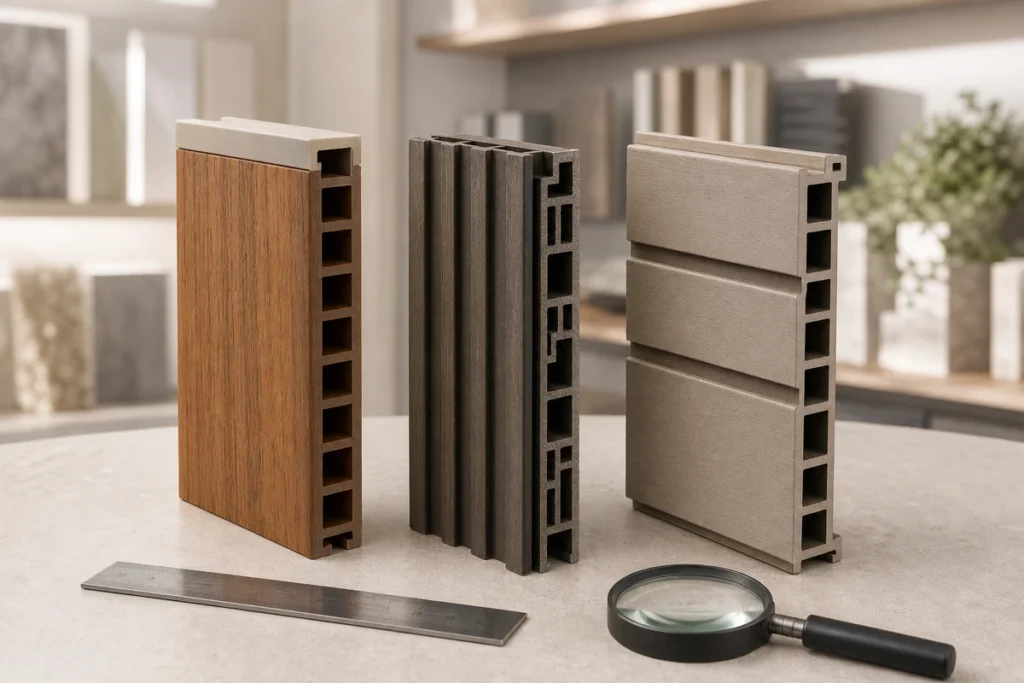
Ask what polymer, wood-fibre proportion, additive package, cap or co-extruded surface, profile thickness, and fixing zone apply to the offered SKU. A weathering study notes that WPC formulations can vary widely in wood particles, polymers, and additives. That range explains why two wood-look boards can age differently.
Request the profile drawing, finish code, intended-use statement, installation guide, test-report number, and approved physical sample together. If a report describes a capped exterior profile but the sample is an uncapped interior panel, the evidence does not transfer.
Step 3: Read Lifespan Evidence in Its Actual Scope
In a 2018 field-and-lab study, WPC deck boards exposed for 9.5 years in Hilo, Hawaii were compared with specimens exposed to fungi for 12 weeks in a laboratory. Some field specimens retained only 15% of original flexural strength. The result shows why severe exposure and product scope matter. It does not predict every wall panel’s life.
That study also found that conditioning small specimens in water at 70°C for five days simulated long-term Hawaii exposure for its particular test pieces. It is useful research, not a specification rule for your facade. A good supplier should explain which report supports which claim, and where the report stops.
A warranty answers a different question from a service-life estimate. For example, Trex states that virtually every product on one regional page has a 25-year limited residential warranty, with an additional 25-year fade-and-stain warranty for certain decking products. That is defined residential coverage, not a universal 25-year WPC lifespan.
Use five checks when you read a claim:
- Does the report name the exact SKU, finish, and profile?
- Which test method, conditioning, and pass criterion does it state?
- Does it cover a sample, a panel, or a complete installed system?
- Does the intended exposure match your project?
- Does the warranty state exclusions, duration, and remedy?
For a wider exterior material decision, compare WPC, ACM, and composite siding before you commit to one facade family.
Step 4: Make the Wall Assembly Part of the Durability Plan
PNNL defines sustained moisture in its siding table as at least 72 hours and advises builders to assume that all siding will leak during its life. Durable exterior cladding therefore needs drainage, drying, flashing, and correct fasteners behind the visible panel.
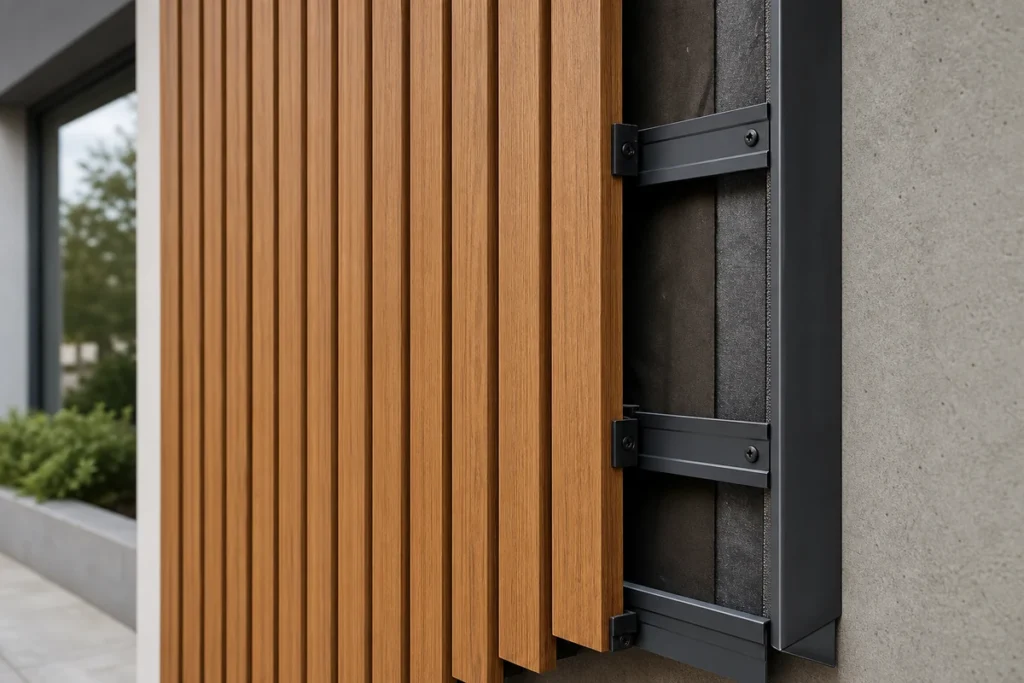
Confirm the substrate, support rail or batten layout, clearance, drainage path, flashing, fastener type, trim, and movement allowance before installation. Do not copy a universal gap or spacing from a blog. Those details must come from the product instructions, the wall design, and local requirements.
The common failures are usually system failures: blocked drainage, unsupported spans, incorrect fasteners, no movement allowance, or a panel used beyond its intended exposure. That is why the finished wall needs review alongside the board.
Step 5: Maintain WPC Without Damaging the Finish
In one laboratory study, a decking profile with 49% wood flour and 51% PVC absorbed 5.12% water after 14 days and 6.32% after 28 days of immersion at 22 ± 2°C. That is a specific test sample, not a wall-panel specification, but it shows why moisture details and care instructions still matter.
Low maintenance should mean a simple, documented routine. Remove dust and debris. Keep drainage and ventilation paths clear. Inspect joints, trims, fasteners, and finish changes. Address leaks or standing water before they become a wall-system problem.
Do not prescribe sanding, sealing, repainting, solvents, bleach, abrasive pads, or pressure-washing settings without the exact supplier’s written approval. Capped, embossed, co-extruded, and surface-finished products can respond differently. Retain the approved sample, finish code, profile drawing, and a short maintenance record for future replacement orders.
When Should You Choose Another Material?
PNNL’s 2026 comparison assigns WPC a low fire-resistance category but high pest resistance and high wind and hail impact resistance. WPC can fit a wood-look, non-structural wall finish. It is not the automatic choice when the required evidence points to another material family.
Choose another system, or pause for specialist review, when the project needs a non-combustible solution, a specific tested facade assembly, unusual structural duty, severe exposure, or a warranty route that the offered WPC profile cannot document. The honest choice may be fiber cement, metal, ACM, or another system with evidence matched to the application.
The right B2B question is not “Which panel lasts longest?” Ask, “Which documented system carries the lowest risk in this exact project?” That question keeps a low board price or a broad material claim from deciding a high-consequence wall specification.
For whole-life buying decisions, use the composite cladding cost guide after you have narrowed the material and system scope.
Frequently Asked Questions
In 2024, the USDA Forest Products Laboratory summarized about 20 years of WPC moisture and fungal research, but it did not assign one lifespan to every profile. The answers below keep that product-and-installation boundary clear.
How long do WPC wall panels last?
There is no universal WPC wall-panel lifespan. The USDA’s 2024 review summarizes about 20 years of moisture and fungal research, while one deck-product warranty offers 25-year limited residential coverage. Neither number guarantees another panel’s service life. Match the SKU, exposure, installation, care plan, and warranty scope to the project.
Does WPC rot or grow mold?
WPC can resist moisture and biological attack better than untreated wood, but it is not rot-proof. The 2024 USDA review explains that moisture-driven microcracks may give fungi access to the wood component. Check drainage, cut edges, ventilation, and the exact product’s intended exposure instead of relying on a generic “waterproof” label.
Can WPC wall panels be used outdoors?
Yes, if the exact panel is designed and installed for outdoor exposure. PNNL defines sustained moisture as at least 72 hours and advises treating all siding as a layer that can leak. An exterior WPC system needs a drainage route, flashing, movement allowance, and scope-matched weather evidence.
Is WPC waterproof?
WPC is better described as moisture-resistant unless an exact product report says otherwise. In a 2021 laboratory study, one 49% wood flour and 51% PVC profile absorbed 6.32% water after 28 days of immersion. That result belongs to that sample and test condition, not every WPC wall panel.
Does WPC need maintenance?
Yes, although it may need less routine finishing than untreated wood. A 25-year limited warranty on a named decking product still includes conditions and exclusions. Follow the supplier’s care instructions, remove debris, protect drainage, inspect joins and trims, and avoid unapproved chemicals or abrasive cleaning.
Conclusion: Select Durable WPC by Evidence
The 2024 USDA review drew on about 20 years of WPC moisture and fungal research and linked long-term risk to moisture-driven pathways into the wood component. Durable WPC is therefore selected by exact product, wall-system, and maintenance evidence, not by a generic label.
Before you order, send WYRAX the project exposure brief, destination market, target profile, quantity, and required documents. We can help you compare samples, test-report scope, MOQ, lead time, and shipment terms for a WPC panel system that fits the job.
About the author
Peter Smith, Marketing Specialist at WYRAX. Peter writes for distributors, contractors, importers, OEM buyers, and specifiers comparing decorative building materials for wall, floor, and ceiling projects. This article should receive named technical review before it makes any SKU, fire, installation, warranty, or code claim.